
Why Sky Burial Isn’t Common practice
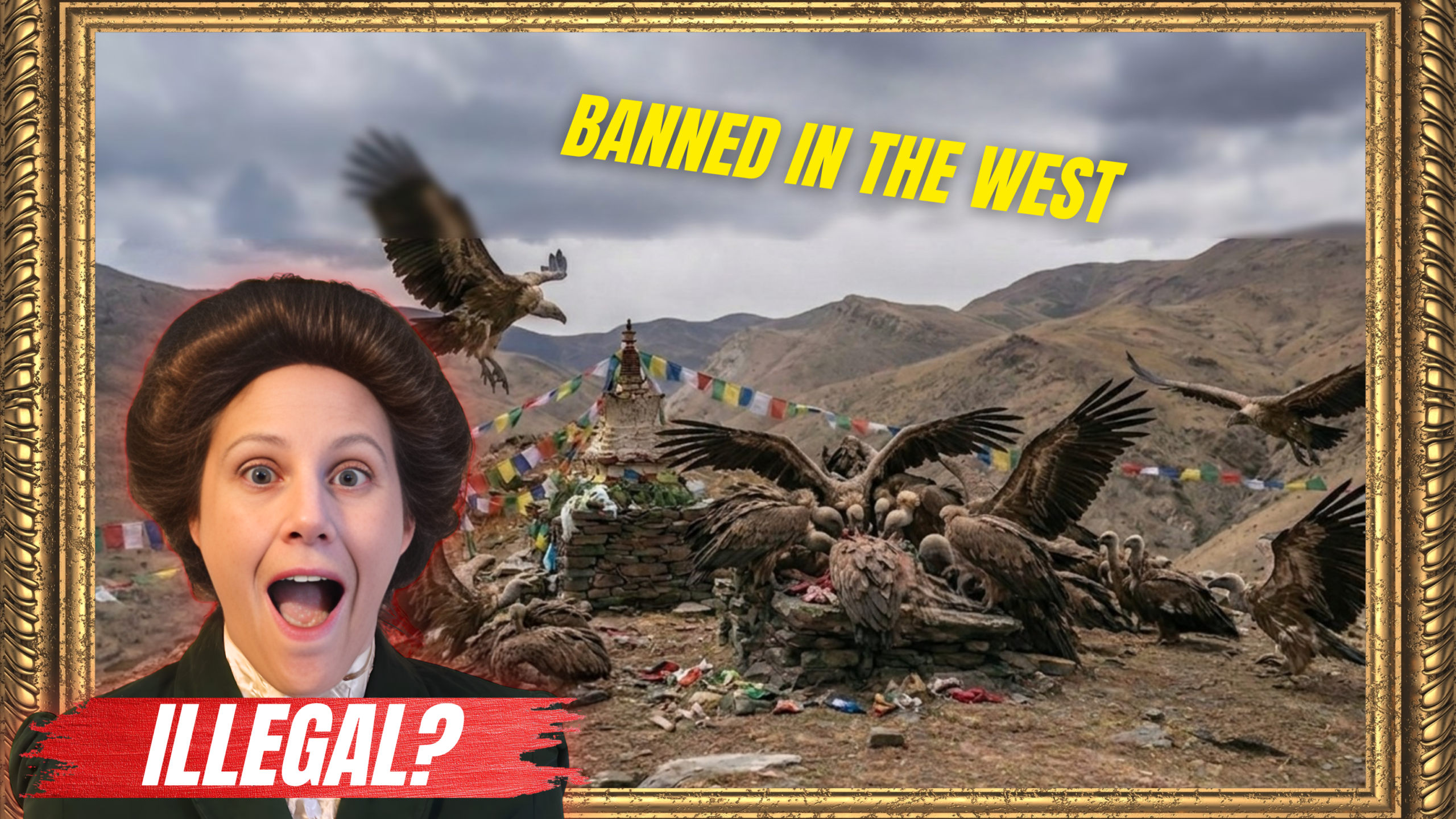
Sky burial comes in a few varieties but is essentially a body disposal method of having vultures eat the dead body in order to dispose of it. Now I’ve been running this channel for quite a few years now, and without fail, every time we do a video on any sort of body disposal, there will always be one or two comments asking why sky burial isn’t common practice or why the West can’t have it.
If it was a one-off, that would be fine, but the amount of times this has been asked, quite frankly, confuses me because—and there is no polite way to say this—I thought it was obvious. But apparently not, so let’s talk about it. If you have just stumbled upon the channel, welcome to Taboo Education, where we talk about death every Friday, so consider subscribing. Now let’s talk about why sky burial isn’t commonplace.
What is it?
For those new to the term and for those who need a refresher, sky burial, the practice of leaving a deceased body exposed to be consumed by vultures and other scavenging birds, remains one of the most striking funerary customs still observed today. It is most closely associated with Tibet, where it is practised alongside parts of Mongolia and Qinghai province in China, and where it is deeply tied to Vajrayana Buddhist beliefs about impermanence and the cycle of rebirth.
A related tradition exists in Zoroastrianism (which we did a video on many years ago). In India and Iran, devotees historically used towers of silence—raised stone platforms on which bodies were laid out for vultures—so as to avoid contaminating the sacred elements of earth, fire, and water. All great, all natural, so why has this practice never spread widely beyond these regions?
Religious and Philosophical Specificity
Sky burial is rooted in specific religious traditions. In Tibetan Buddhism, it reflects the belief that the body is merely an empty vessel once the consciousness has departed, and that offering it to birds is an act of generosity, a final gesture of compassion towards other living beings. In Zoroastrianism, the logic is different again: earth, fire, and water are considered sacred and must not be defiled by contact with a corpse, so exposure on a tower of silence was seen as the only way to dispose of the body without polluting these elements.
Both rationales are highly specific to their respective belief systems and are not shared by most of the world’s major religions. Christianity, Islam, and Judaism generally emphasise burial or, in some Christian traditions, cremation, with strong doctrines around bodily respect and resurrection. Hinduism favours cremation for its own cosmological reasons. Without a doctrinal framework of this kind, there is little religious motivation for other cultures to adopt sky burial. It also goes without saying that many people would find the practice undignified and disrespectful. But that reason is really small fry compared to the other reasons.

Geographic and Ecological Constraints
Sky burial developed in landscapes where it was, in many ways, the most practical option available. The Tibetan Plateau is largely rocky, frozen for much of the year, and short of timber, which makes both burial and cremation genuinely difficult. Digging a grave in ground that is frozen solid for months at a time is gruelling, and firewood suitable for cremation is scarce at high altitude. Crucially, Tibet also has one of the world’s largest surviving populations of Himalayan griffon vultures, birds large and numerous enough to consume a body within a couple of hours.
These conditions simply do not exist in most parts of the world. Temperate and tropical regions typically have softer soil and accessible timber, and even where large scavenging birds are present, they are rarely available in the numbers needed to make the practice reliable. This is precisely the problem that has undermined Zoroastrian sky burial in modern times. India’s vulture population collapsed by more than 95 per cent from the 1990s onwards, largely due to a livestock anti-inflammatory drug that proved lethal to vultures feeding on treated carcasses. With too few vultures left to consume bodies quickly, Parsi communities in Mumbai have had to install solar concentrators on the towers of silence to speed up decomposition, and many families have turned to burial or cremation instead.
The Vulture Problem
The vast majority of countries have no native vulture population capable of supporting this practice at all, and vultures cannot simply be introduced on demand. Establishing a viable population would mean importing and keeping birds (or any other animal) specifically for the purpose, effectively farming an animal to service human death rites. Beyond the practical difficulty of this, there is something uncomfortable about the idea in its own right: bending a wild species to a captive, human-scheduled role is arguably just another instance of humans reshaping nature for their own convenience.
Even where wild vultures exist, they need to learn where and when a meal will reliably appear. Vultures do not descend on a body the way scavengers might randomly do on meat they happen across. In Tibet, generations of consistent practice at fixed sites have effectively trained local vulture populations to associate those locations with food, and to gather in the numbers needed to consume a body quickly. A single family taking up the practice in isolation would not produce the regular, predictable supply that keeps a resident vulture population coming back.
“Sky burial only works as a sustained, collective practice, not as an occasional individual choice. For me, this is the most obvious point to take into account when answering this question.”
Hygiene and Practical Complications
Even where vultures are present, the practice carries genuine hygiene and logistical difficulties that make it unsuitable for widespread adoption. Vulture droppings accumulate heavily around feeding sites, and Zoroastrian towers of silence have historically needed careful drainage systems to manage this.
More troubling is the birds’ habit of regurgitating when startled or when taking off suddenly in flight, a natural defence mechanism that lightens their load so they can escape more easily. A disturbed bird can carry a partly consumed meal for a considerable distance before bringing it back up, so remains from a sanctioned exposure site could plausibly turn up kilometres away, in a park or backyard well outside any area the public associates with the practice. A pile of human bones and flesh appearing in an ordinary neighbourhood, with no obvious explanation, would understandably prompt a police investigation and public alarm.

Legal and Public Health Barriers
Modern public health law is another major obstacle. Most countries have strict regulations governing the disposal of human remains, generally requiring burial in a registered cemetery, cremation in a licensed facility, or another sanctioned method. These laws exist partly to prevent the spread of disease and partly to regulate land use and maintain public order. Leaving a body exposed in the open would breach these regulations almost everywhere outside the areas where sky burial is formally permitted and culturally understood.
Practical Logistics
Finally, sky burial requires specific infrastructure and expertise that most places lack. Traditionally, the process is carried out by trained practitioners, who ritually prepare and cut the body so that the vultures can consume it efficiently. Purpose-built sites need to be established and maintained well away from settlements, which raises a further practical question: how does a family actually get a body there? A site remote enough to avoid hygiene problems is difficult to reach. Someone has to transport their deceased loved one over rough or unmarked terrain to a specific fixed location, on a predictable schedule.
You may like this practice and want it because you see it as natural and beautiful, but recreating it outside of areas where it organically developed would require many unnatural and probably unethical things to occur. Sky burial persists where it does because it emerged from a very particular combination of belief, environment, and necessity. Hopefully, it becomes clear why sky burial has remained a distinctive regional practice rather than a global one. And with that, go talk death.
Advanced Care Workbook
A meticulous guide for cleanly and legally documenting personal and medical values before transitions occur.
Access Digital Workbook →Death Literacy Checklist
An actionable diagnostic tool designed for individuals and workplace teams to gauge existential readiness.
Download Free Audit →
Leave a Reply