
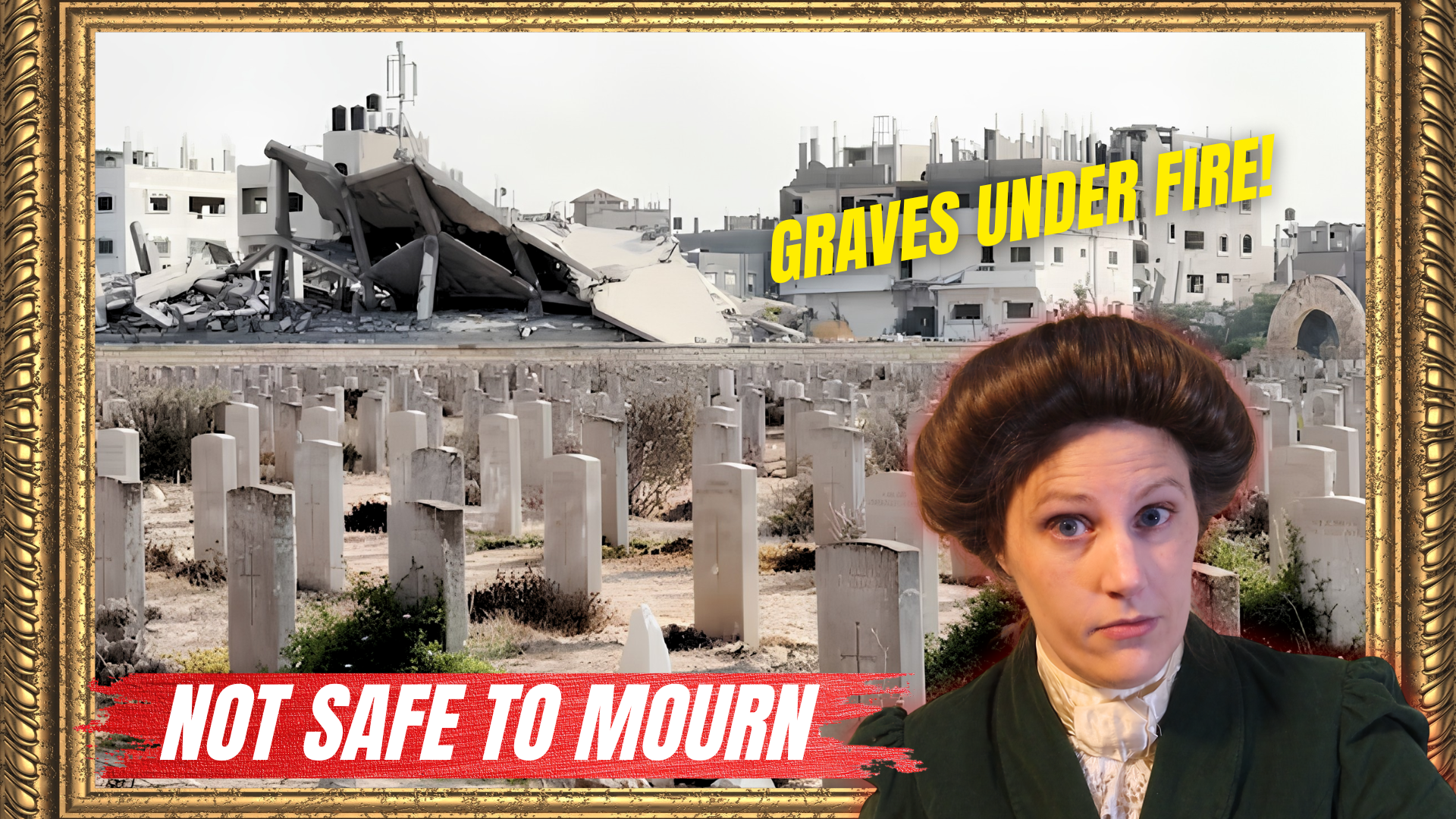
Graves Under Fire: How Cemeteries Become Casualties of War
A cemetery is meant to be the one place a community can set aside its conflicts. They are ground reserved for grief rather than grievance. Yet across the history of armed conflict, from the trenches of the First World War to the rubble of Gaza today, cemeteries have repeatedly been drawn into the fighting itself.
They have been shelled to break civilian morale, dug up to search for hostages or evidence, and occupied by combatants who understand that tombstones and mausoleums make excellent cover. At the same time, ordinary families caught in war zones have had to face an agonising practical problem: how do you bury someone you love when the ground itself is a battlefield? Welcome to Taboo Education, where every Friday we talk about death from a variety of angles. Now, let’s talk about cemeteries during wartime.
Cemeteries as Targets: Destruction Designed to Terrorise
In some conflicts, the destruction of cemeteries is not incidental damage but a deliberate tactic aimed at civilians. During the siege of Sarajevo in the 1990s, Bosnian Serb forces routinely shelled and sniped at funerals as they took place. Mourners at the graveside of a young girl were fired upon while laying flowers, and gravediggers were shot at while digging, forcing families to bury their dead under cover of darkness. Imams sometimes had to hide behind coffins to finish funeral prayers while shells fell around them.
Historians of the siege have noted that this was not a case of military operations going wrong: attacking funerals was a calculated method of inflicting terror on a trapped population, denying them even the dignity of mourning in safety.
A similar pattern is visible in modern conflicts like the war in Gaza. Human rights monitors have documented that dozens of Gaza’s cemeteries have been bulldozed or severely damaged, with graves flattened, remains mixed together, and headstones removed. This includes the Gaza War Cemetery, a Commonwealth War Graves Commission site holding more than 3,600 Allied service members from the First and Second World Wars. Rights organisations argue that mixing and destroying remains constitutes a war crime, stripping families of the ability to identify their dead or ever prove what happened to them.

Cemeteries as Battlegrounds: Graveyards Used for Cover
Beyond deliberate destruction, cemeteries have also served as improvised fortresses for fighters seeking to avoid detection and return fire. Their dense clusters of mausoleums, crypts, and headstones offer natural cover that is difficult for an advancing force to clear.
One of the starkest modern examples came in 2004, when US Marines and soldiers fought Mahdi Army militiamen through the vast Wadi al-Salaam cemetery in Najaf, Iraq—the largest burial ground in the world. Fighters moved between tombs and underground crypts, storing weapons, launching ambushes, and hiding within the graveyard. The Najaf fighting illustrates a recurring dilemma of urban warfare: sacred or protected sites lose much of their legal protection under international humanitarian law once they are used for military purposes, yet the resulting battles still desecrate grounds that communities regard as sacrosanct.
The Struggle to Bury the Dead
For families living through war, simply reaching a graveyard or finding space in one can become its own crisis. During the siege of Sarajevo, the city’s main cemetery lay too close to the front line, forcing residents to improvise. The football pitch at the Olympic Stadium was turned into a burial ground, and people in the suburbs sometimes had to bury relatives at night in front of their own apartment blocks to avoid sniper fire.
Syria’s civil war produced the exact same problem. In Aleppo, both the old and new city cemeteries ran out of room entirely, leaving bodies buried in backyards, parks, and playgrounds, marked with only token headstones. In the Damascus suburb of Eastern Ghouta in 2018, mourners burying bombing victims in a makeshift cemetery were themselves struck by an airstrike moments later, turning a funeral into another mass casualty event.
“In protracted, besieged conflicts, burial stops being a private family matter and becomes a logistical and often life-threatening undertaking.”
No Time to Choose: Hygiene, Speed and the Loss of Options
Wartime burial is also shaped by a harder, more clinical pressure: the need to dispose of bodies quickly for public health reasons. In a siege or active combat zone, there is no possibility of extended timelines or cremation, which requires fuel, electricity, and infrastructure that besieged areas simply lack.
Decomposing bodies start to pose a genuine public health risk, so hasty burials completed within minutes—without prayers, full identification, or family present—become necessary. The living are making an impossible trade-off between honouring the dead properly and protecting those who are still alive.

An Old Problem in a New Century
What this reveals is how much choice most people in stable, peaceful countries take for granted. The quiet assurance that a loved one’s resting place will not be shelled, bulldozed, or built over is a privilege built on peace, not a universal feature of human experience.
International humanitarian law affords cemeteries special protection as civilian and cultural sites, yet that protection repeatedly proves conditional. Whether in Bosnia, Iraq, Syria, Ukraine, or Gaza, the pattern recurs: the dead of war rarely rest undisturbed, and the living are left to grieve in circumstances that deny them even basic dignity. And with that, go talk death.
Advanced Care Workbook
A meticulous guide for cleanly and legally documenting personal and medical values before transitions occur.
Access Digital Workbook →Death Literacy Checklist
An actionable diagnostic tool designed for individuals and workplace teams to gauge existential readiness.
Download Free Audit →
Leave a Reply