It occurred to us the other day: Taboo Education is a death literacy channel with well over 200 long-form videos under our belt, and yet we haven’t officially dived into one of the most foundational psychological frameworks surrounding death anxiety. Today, we are correcting that. Welcome to Terror Management Theory (TMT)—the psychological framework arguing that death anxiety is the hidden engine driving almost all of human behavior, whether we are brave enough to admit it or not.
You are going to die. You already knew that. But here is the part your brain aggressively resists: that knowledge is so deeply threatening that your entire personality, your political views, your religion, your tribe, and your need to feel special are largely elaborate defense mechanisms constructed to keep you from confronting your own mortality.
Developed in the 1980s by researchers Jeff Greenberg, Sheldon Solomon, and Tom Pyszczynski—building on Ernest Becker’s Pulitzer Prize-winning book The Denial of Death—Terror Management Theory argues that human civilization is, at its core, one long collective attempt to pretend we aren’t animals destined to rot in the ground.
What Is “Mortality Salience” and Why Does It Matter?
Mortality salience is simply the psychological term for how consciously aware you are of your own death at any given moment. When mortality salience is high—when death feels immediate or real—something fascinating happens in the human brain. You don’t automatically become wiser, kinder, or more present. Instead, you get defensive.
Researchers have proven this in hundreds of experiments using a method that is almost embarrassingly simple: they ask participants to write a short paragraph about what it feels like to think about their own death, and then observe their behavior immediately afterward.
The results are consistently disturbing:
People become significantly harsher in their judgments of others.
They exhibit greater hostility toward anyone with differing worldviews.
They cling tighter to their group, nation, or cultural identity.
They show a stronger impulse to punish social rule-breakers and reward those who validate their own beliefs.
In one landmark study, judges were asked to set hypothetical bail for a minor offense. Half of the judges were asked to complete a brief death-writing exercise first. The control group set average bail at $50. The judges reminded of their mortality set bail at $455—nine times harsher—for the exact same case, purely because their death anxiety had been quietly triggered.
When mortality salience rises, human psychology instinctively retreats behind defense mechanisms and group conformity.
The Two Shields We Use to Keep Existential Panic at Bay
According to TMT, human beings manage existential dread using two primary psychological mechanisms:
1. Symbolic Immortality (A Meaningful Worldview)
Every culture in history has built belief systems that grant life meaning beyond an individual’s lifespan. Religion is the classic example, offering literal immortality through an afterlife. But secular worldviews do the exact same job: believing your nation matters, that your children carry your legacy, or that your life’s work will outlast you. Becker called this symbolic immortality. You cannot live forever, but your legacy, group, or ideas can—and that takes the sharp edge off existential panic.
2. Self-Esteem (Feeling Worthy in a Meaningful World)
In TMT, self-esteem isn’t just “feeling good about yourself.” It is the felt sense that you are a valuable contributor to a meaningful universe. When you feel like you matter, death feels slightly less terrifying. When you feel insignificant, mortality becomes unbearable because there is no symbolic immortality to rely on. This explains why people who feel powerless often compensate so aggressively through road rage, rigid nationalism, or a desperate need to always be right.
Help Us Fund Sam’s Upcoming Book!
We are officially crowdfunding for our upcoming book, “But It Would Never Happen To Me”. This community-backed project explores how mortality impacts every lifespan stage. Help us bring these vital insights to print!
Clashing Immortality Projects: Why Good People Do Terrible Things
This is where Becker’s theory turns truly dark. When two groups hold fundamentally different worldviews, they are not merely having a disagreement—they are threatening each other’s defense systems against death anxiety. If your worldview says life means one thing, and mine says the complete opposite, one of us is relying on a lie. Your nervous system perceives that ideological difference as an existential threat.
This explains the horrifying mechanics of war and historical atrocities. When people die for an ideological cause, their group cannot psychologically afford to let those deaths feel pointless. The sacrifice must be validated by continuing the fight, creating a tragic cycle where more people die to prove that previous deaths meant something.
TMT reveals that atrocities are rarely committed by cartoonish monsters; they are carried out by ordinary human beings who have surrendered their moral agency to an “immortality project” because they desperately need their lives—and deaths—to matter.
Cults, Extremism, and the Weaponization of Unacknowledged Fear
Extremist groups and cults are, at their core, master salespeople of symbolic immortality. They target individuals whose meaning-making frameworks have collapsed, offering absolute certainty, radical belonging, and a grand cosmic narrative where individual death becomes glorious rather than terrifying.
This is precisely why death literacy is a vital societal defense mechanism:
Nuance demands effort: Nuance acknowledges that life is complex and death is real. Extremist groups sell absolute certainty.
Death literacy builds psychological immunity: A person comfortable sitting with mortality is vastly harder to radicalize because they do not carry unacknowledged existential terror waiting to be weaponized by loud, confident leaders.
Resilience over reaction: True death literacy isn’t just soft comfort; it is structural protection against psychological manipulation.
Building authentic death literacy long before a crisis strikes creates lifelong resilience against existential anxiety.
Why “Just Doing a Grief Workshop” Isn’t Good Enough
For decades, standard institutional responses treat death purely as a crisis management problem: hand out a brochure when someone is actively dying or grieving, tick the box, and move on. But Terror Management Theory shows us that everyone—from young children asking honest questions to middle-aged adults quietly panicking—has an active relationship with mortality every single day.
When society refuses to give people open, honest frameworks for death early in life, they cope by repressing the anxiety, leading to rigidity, hostility, and fear. Waiting until the end of life to discuss mortality is like placing an ambulance at the bottom of a cliff. Taboo Education exists to build capacity before the cliff.
Death literacy isn’t about pretending death is comfortable—it’s about building the psychological strength to look at it directly, alongside others, long before the crisis arrives. Face the discomfort, protect your mind, and go talk death.
Death Literacy & Resilience Tools
Advanced Care Workbook
A meticulous guide for cleanly and legally documenting personal and medical values before transitions occur.
Most conversations about death literacy focus heavily on individuals and families. We talk at length about planning for your own end-of-life logistics, having uncomfortable conversations with aging parents, and knowing exactly what steps to take when a family member dies at home. But there is an entire group of people who are almost completely left out of this conversation, and they face some of the most complex, systemic, and damaging consequences when death arrives unannounced: business owners.
Whether you run a sole trader operation, a small family business, or a company with a growing team of staff, sudden death or serious incapacity can instantly unravel everything you have poured your life into building. And the profound tragedy is that most of it is entirely preventable with a baseline layer of knowledge and some strategic forward planning.
If you are employed by someone else and you die, it’s devastating for your family. But the organization you worked for will keep functioning. There are systems, backups, and HR processes. If you own the business, you often are the system.
When you are the founder or small business owner, you hold the key client relationships. You hold the master passwords. You sign the legal contracts, manage the critical suppliers, and keep the operational engines running day in and day out. When a business owner dies without preparation, the business can completely collapse within days—not because nobody cares, but because nobody left behind knows what to do or even where to start.
Without clear structural preparation, a business owner’s sudden absence transforms a thriving asset into a chaotic administrative nightmare.
What Death Literacy Actually Looks Like for a Business Owner
Death literacy in a corporate context means deeply understanding the practical, legal, and relational landscape that surrounds your business structure, and taking proactive steps to document and communicate that landscape clearly before you die or become incapacitated.
It fundamentally encompasses three pillars:
1. Knowing Your Business Structure
Are you operating as a sole trader, a partnership, a company, or a trust? Each of these setups dictates a completely different legal outcome when an owner dies. A sole trader’s business instantly ceases to exist as a legal entity upon death. A company, on the other hand, legally continues to exist because it is a separate entity from you. Understanding where you sit structurally is the true starting point.
2. Maintaining a “Business-Aware” Will
A standard personal will rarely addresses a commercial entity adequately. If you own shares in a company, your will can direct who receives those shares. But if you are a partner in a business, your partnership agreement may entirely override your will. Many business owners have absolutely no idea this is the case until it is tested by crisis.
3. Documenting Legal and Operational Authority
Your executor will inherit authority over your personal estate, but do they possess the legal standing, industry knowledge, or access codes to actually run your business while it’s being wound up or transferred? In most cases, the answer is no. A well-prepared owner will systematically document who should step in, what authority they need, and exactly how to get it.
Help Us Fund Sam’s Upcoming Book!
We are officially crowdfunding for our upcoming book, “But It Would Never Happen To Me”. This community-backed project explores how mortality impacts every lifespan stage. Help us bring these vital insights to print!
There’s a reason we avoid this conversation, and it isn’t just a general social awkwardness about mortality. For most business owners, the company is deeply personal. It’s a massive pillar of their identity. Thinking about what happens to it when they die can feel like confronting their own absolute irrelevance.
But death literacy asks us to completely reframe that fear. Thinking about what happens to your business after you die is not an act of morbidity—it is a supreme act of care.
It is care for your family, who may otherwise inherit an incredibly complex financial mess during their deepest grief. It is care for your employees, whose ongoing jobs and livelihoods depend entirely on the institutional decisions you make today. It is care for your clients, who trusted you with their business. And it is care for yourself, because there is an enormous sense of peace in knowing your legacy and reputation will remain intact under your terms.
5 Practical Steps Every Business Owner Should Take
You don’t need to have your entire succession framework perfectly sorted overnight. But there are baseline foundational steps worth taking right now:
Get a business-aware will: Work closely with a specialized solicitor who understands commercial business structures, not just simple personal estates.
Document your business operations: Who are your key suppliers? Where are your primary contracts stored? What are your login credentials? This vital operational data must exist somewhere secure that a trusted person can access without needing you.
Consider a buy-sell agreement: If you are in a partnership or have co-owners, a buy-sell agreement sets out exactly what happens to a deceased partner’s share. Without one, your remaining partners could suddenly find themselves in business with your spouse or children, creating a highly stressful environment for everyone.
Bring your accountant and solicitor together: Business succession sits heavily at the intersection of legal and financial advice. Aligning these professionals early saves your family massive complexity later.
Tell someone: Documenting your plans is only half the battle. Tell your partner, your co-owner, or your key employee exactly where the emergency documentation is stored. A hidden folder is just as useless as no folder at all.
Does Being Death Literate Make You a Better Boss?
Here is where the conversation turns from a defensive insurance policy into a competitive advantage. There is a strong, empirical argument that building death literacy actually makes you a far better leader while you are still very much alive and running things day to day.
Consider what death preparation requires of you. If you are seriously organizing your business to survive your sudden absence, you naturally end up documenting processes, decentralizing institutional knowledge, and systematically reducing single points of failure. That isn’t just good death preparation—that is world-class management. A business that could survive your absence is a business that already runs more efficiently, with less operational bottlenecking centered on you.
Decentralizing control and planning for contingency builds deep operational resilience and corporate trust.
It also forces you to become a more transparent communicator. Leaders who actively avoid thinking about mortality tend to avoid other hard business conversations too: succession planning, capability gaps, or how decisions get made when the primary decision-maker is out of pocket. Pushing through this barrier builds incredible trust. Staff deeply respect a leader who shows structural competence and foresight rather than one who pretends nothing bad will ever happen.
Facing finitude permanently shifts a leader’s psychological priorities. Founders who have genuinely sat with the reality of their own absence become less reactive to short-term, daily pressures and far more focused on what truly matters: the health of their people, the long-term vitality of the business, and the authentic legacy they are building over time.
Death literacy is ultimately about living and leading more consciously. Your business represents years of your life, your family’s financial baseline, and the livelihoods of people who trust you. The most generous, professional thing you can do as a founder is to make sure the people you leave behind aren’t forced to figure it all out from scratch in the middle of their grief.
Protect what you’ve built, empower your team, and go talk death.
Business Resilience Frameworks
Advanced Care Workbook
A meticulous guide for cleanly and legally documenting personal and medical values before transitions occur.
There is a popular assumption that death education is a niche package. Something you pull off the shelf only when someone is actively dying, when you’ve just lost a loved one, or when you’re filling out the paperwork that confirms you do, in fact, have an estate. A will. A power of attorney. Maybe a few tidy thoughts on whether you’d prefer burial or cremation.
Very practical. Very structured. Very much not the point.
The clinical data tells a completely different story. As it turns out, your relationship with mortality is quietly running the show for almost every single area of your life, whether you choose to acknowledge it or not. The only question is whether you are managing it consciously, or whether it is managing you from the shadows.
When I tell people I work in death literacy, everyone assumes I only talk about wills, funerals, and grief. But those elements are a tiny fraction of what death awareness actually changes.
This deep dive stems from a distinct professional frustration. The modern death-positive movement has become hyper-focused on body disposal methods, green burial aesthetics, and the immediate mechanics of end-of-life care. While those initiatives are deeply necessary, they create an absurd disconnect: we expect individuals to seamlessly navigate end-of-life crises when they haven’t spent a single day of their active lives developing a relationship with mortality.
Let’s take a completely unnecessary tour through what death literacy actually dictates across an entire lifespan.
1. Death Anxiety Is a Mental Health Issue Wearing a Trench Coat
Before unpacking demographic anomalies, we must establish a core psychological truth. A definitive 2024 meta-analysis led by Rachel Menzies and colleagues at the University of Sydney (published in Clinical Psychology Review) analyzed data from 104 papers representing over 24,000 participants. They confirmed a profound, undeniable correlation between unmitigated death anxiety and overall mental health symptoms.
The researchers described death anxiety as transdiagnostic. This means it is an existential undercurrent that feeds an array of clinical issues rather than neatly belonging to any single condition. Long-term, unprocessed death anxiety is a core driving engine behind:
Health Anxiety & Panic Disorder: A hyper-vigilance to bodily changes misread as immediate fatal threats.
Obsessive-Compulsive Disorder (OCD): Specifically where cleaning, contamination fears, and counting rituals function as an unconscious defense against decay and physical harm.
General Anxiety & Depression: An underlying dread regarding the limitations of time and lack of control.
Approximately one in five Australians experiences a mental health condition in any given year. A massive, unaddressed portion of that psychological burden is simply death anxiety with nowhere to go—ignored by a clinical landscape that rarely trains practitioners to look for it.
Unconscious existential dread regularly masquerades as chronic generalized anxiety and compulsive behaviors.
2. Teenagers Aren’t Invincible—They Think They’re Already Dead
The conventional cultural script claims that teenagers engage in reckless behavior because they feel completely invincible. They supposedly believe they will live forever. The empirical evidence shows that the exact opposite is true.
Pioneering research by Baruch Fischhoff and colleagues revealed that 15- and 16-year-olds wildly overestimated their immediate probability of dying within the year at approximately 19%, and their chance of dying before exiting their teens at 20%. These figures are mathematically catastrophic compared to actual, nominal adolescent mortality rates.
This psychological state is known as fatalism—the implicit belief that a short life is inevitable. Longitudinal data from the massive Add Health cohort (tracking over 20,000 adolescents) established that teenagers who perceived a 50-50 or lower chance of living to age 35 were drastically more likely in young adulthood to:
Suffer from chronic suicidal ideation and attempt suicide.
Engage in heavy, self-destructive substance abuse.
Completely discard the motivation to delay gratification for future benefits.
If a young person unconsciously believes they won’t be around to inherit a future, the evolutionary case for protecting that future completely collapses. Death literacy for adolescents is not a soft exercise in processing grief; it is a vital identity intervention. By establishing an honest, non-panicked relationship with reality, programs like the evaluated “Beyond the Wall” curriculum have proven to rapidly lower high-risk behavior by giving teens a future-oriented framework worth investing in.
Need to Streamline Your Group’s System Literacy?
Sam delivers raw, evidence-backed professional development workshops for corporate, mining, healthcare, and educational institutions across Australia.
3. The 25 to 55 Bracket: The Most Anxious Demographics Alive
Counterintuitively, older populations consistently demonstrate the lowest baseline levels of death anxiety. The peak of existential terror belongs almost exclusively to middle adulthood—the 25 to 55 demographic. This is the over-extended, stressed-out engine room of society carrying the mortgages, the career ladders, the children, and the aging parents.
The Sandwich Generation & Unnamed Grief
Data from the National Institutes of Health indicates that nearly two-thirds of sandwich-generation caregivers experience intense, sustained emotional strain. What is rarely named by professionals is that this strain is predominantly anticipatory grief. Watching a parent slowly decline through dementia or physical failure is a prolonged, ambiguous loss that occurs over years.
Because our culture lacks existential language, this grief is rarely processed. Instead, it expresses itself as erratic irritability, burnout, and systemic family friction. Death literacy provides a definitive diagnostic name for this state. It shifts a caregiver from a state of chaotic emotional drowning to structured, conscious treading water.
The Midlife Crisis Reworked
In middle adulthood, an individual’s relationship with time undergoes a profound structural shift. Instead of unconsciously counting years *since birth*, the mind begins calculating time *until death*.
When this reality hits a psychological system completely devoid of death literacy, the results are predictably catastrophic. The classic, stereotypical midlife crisis—the impulsive affair, the erratic financial purchases, the sudden identity pivots—is nothing more than a desperate, unmediated response to sudden mortality salience.
Alternatively, the empirical data shows that conscious, deliberate contemplation of one’s finitude radically increases intrinsic goal orientation, slashes superficial selfishness, and accelerates authentic identity integration. It turns an identity breakdown into a genuine psychological evolution.
The midlife transition marks a permanent psychological shift from tracking years lived to evaluating time remaining.
4. The Immortality Projects: Career, Consumerism, and Media
When death anxiety remains unconscious, it forces individuals to build what Ernest Becker defined as “immortality projects”—subconscious systems designed to bypass the reality of physical death by achieving symbolic significance.
The Parent Trap: Parents lacking death literacy routinely turn their children into immortality vehicles. They over-invest in their children’s precise achievements and choices because they cannot sit with their own finitude. A death-literate parent can separate their own existential security from their child’s life, allowing them to parent the actual human being in front of them.
Exploitative Materialism: Published consumer research by Arndt & Solomon confirms that sudden, subtle reminders of death dramatically spike materialistic aspirations and impulsive buying intentions. When people are existentially insecure, they cling desperately to physical possessions and wealth as a symbolic psychological buffer.
The Political Pipeline: Extensive meta-analyses spanning thousands of global participants prove that raw mortality salience instinctively drives humans toward aggressive in-group favoritism, intense hostility toward out-groups, and a sudden craving for charismatic, authoritarian leaders who promise absolute protection.
The endless cycle of fear-mongering media and tribalist politics works precisely because your unaddressed death anxiety is an incredibly lucrative fishing pond. A death-literate individual is fundamentally un-hookable. They can sit comfortably with existential discomfort without needing to purchase a product or find a political scapegoat to feel safe.
5. Early Retirement: The Collapse of the Primary Shield
Here is a clinical reality that is completely excluded from financial retirement planning conversations: a staggering 41% of retirees experience moderate to severe identity disruption within the very first year of leaving the workforce.
For forty years, a career functions as an individual’s primary immortality project—the ultimate boilerplate answer to whether their existence matters. The second that framework is removed, the existential questions do not retire; they simply stop being answered.
A person entering retirement without strong death literacy is instantly exposed to a concentrated wave of mortality salience as peers begin to fall ill. Without a pre-built internal framework of meaning unrelated to institutional productivity, post-retirement depression frequently sets in as an anticipation of ultimate non-existence.
Purpose is not a soft psychological luxury; it is highly physiological. Definitive longitudinal data directly links a firm, conscious sense of existential purpose in early retirement with significantly lower mortality risks, vastly improved sleep architecture, and sharply reduced clinical depression rates over the subsequent decades. Purpose dictates whether your biology functions.
Retirement systematically dismantles a person’s primary societal identity, exposing them directly to unmediated existential questions.
The Choice Is Singular
We have somehow collectively agreed to a bizarre societal framework where one of the most powerful determinants of mental health, parenting dynamics, consumer vulnerability, and political radicalization is treated as a niche specialty to be ignored until an absolute crisis occurs.
Unconscious death anxiety leaves you entirely exposed to systemic manipulation, chronic treading water, and reactive life choices. Conscious, processed death literacy creates an unshakeable groundedness, deep generational legacy motivation, and true personal autonomy.
It is not a niche conversation for the end of life. It is the foundational landscape of living well.
Go talk death.
Lifespan Death Literacy Frameworks
Advanced Care Workbook
A meticulous guide for cleanly and legally documenting personal and medical values before transitions occur.
This video has become an international sensation, racking up over 700,000 views and 55,000 likes. Watch the full breakdown below.
For our regular viewers, this video is going to be a departure from our usual death-related content. But as you will have noticed, critical thinking is something we strongly advocate on this channel. And that is exactly what this video is about.
It is for everyone who has ever asked themselves, “Does the US even have an education system? Is it optional?” It is for everyone who sees the brain rot coming out of the US day after day and genuinely wondering why.
It is for everyone asking how a nation of 335 million people ended up with the biggest village idiot on the planet as president. Since that brain rot is now affecting our kids and that village idiot is actively affecting our lives, many of us outside the US are demanding an explanation.
I too wanted an answer to these questions, and since I love to research anything and everything, this became the rabbit hole that I went down over the past few months. What I found is too important not to share, and it’s a 250-year-old story. The first half of this video explains to the international community how America got itself into this mess. And the second half explains to Americans why the international community is done being diplomatic about how we feel about it.
Buckle up, it’s going to be a long, bumpy ride.
What is Critical Thinking and Why Does it Matter?
Since that is what this video is essentially about, let’s define it. Critical thinking is not about being clever or contrarian or difficult. It is the ability to evaluate a claim before accepting it.
To ask where that information comes from, who benefits from you believing in it, whether that evidence actually supports the conclusion, and whether you would accept the same argument if it came from the other side. It is, at its core, the ability to change your mind when the evidence demands it.
That is it. That is the whole thing.
When a population lacks critical thinking skills, they make medical, financial, and political decisions based on what feels true rather than what is demonstrably true.
When a population lacks critical thinking skills, the consequences are not abstract. People cannot identify when they are being lied to. They cannot distinguish between a credible source and a fabricated one. They make medical, financial, and political decisions based on what feels true rather than what is demonstrably true.
They are easy to manipulate, easy to sell to, easy to frighten, and easy to turn against each other. They vote against their own interests. They trust the people who are harming them. They distrust the people who are trying to help them. And they can be convinced that all of the above is actually freedom.
Every single thing this video covers—the school system, the media, the exported dysfunction, the slide towards authoritarianism—is what happens without this skill as part of your culture. Keep that in mind as we go forward.
One more thing before we go further because someone will make the comment if we don’t bring it up. This video is not arguing that Americans are stupid.
335 million people have the same range of intelligence as any other population on Earth. The same distribution of IQ, the same capacity for brilliance, the same capacity for analytical thought. Some of the most rigorous thinkers, scientists, journalists, and critics in the world are American.
What this video is arguing is that a system was deliberately built to prevent a very, very large portion of the population from developing and using the skills of critical thinking, self-awareness, and emotional intelligence. And that is a very different claim. And if you genuinely think all Americans are stupid, you are clearly deficient in critical thinking skills yourself. So you might not want to throw stones.
A Nation Founded on Anti-Intellectualism
Let’s start with a statement that sounds provocative but is on examination simply accurate. The United States of America is the only known country in the world throughout history that was deliberately, structurally, ideologically from the ground up founded on anti-intellectualism.
Not a country that tried to revoke knowledge. A country that had anti-intellectualism written into its foundational cultural DNA before the ink on its constitution was dry.
That is genuinely batshit crazy, but it does answer a lot of questions.
The dominant story America tells itself is the myth of the self-made man who didn’t need schooling, just grit and “common sense.”
Anti-intellectualism, if you want a formal definition, is a hostility towards or distrust of intellectuals, intellectual pursuits, and expertise. The idea that knowledge is suspicious. That educated people are probably up to something. That gut feeling and common sense are more trustworthy than evidence and analysis. That the person who has spent 30 years studying a subject has less credibility than the person who read about it on their phone on Tuesday.
Most countries have pockets of anti-intellectualism. It exists everywhere to some degree. What makes America categorically different is that anti-intellectualism was not a reaction to its founding institutions. It was part of them. It was present at its creation and it was useful to the people doing the creating.
The dominant story America tells itself is the story of the self-made man. The rugged individualist who didn’t need schooling, didn’t need experts, didn’t need anyone’s help, just grit, faith, and common sense. This archetype goes back to the very earliest European settlers, many of whom were religious communities that left Europe specifically because they found it too tolerant, enlightened, and intellectually open.
They were not fleeing oppression so they could build a society of free inquiry. They were fleeing because they wanted to build a society where the truth was already settled by God, by scripture, by community elders, and it was not up for debate.
Now, yes, the founding fathers, some of them were genuinely brilliant. Jefferson, Madison, Franklin, Hamilton—educated, widely read, deeply influenced by European enlightenment thought. But here’s what the mythology leaves out:
Those men were the elite, wealthy, traveled, multilingual, and they were mistrusted for it almost immediately by large portions of the population they were supposedly leading.
The first great organized expression of anti-intellectualism as a political force arrived with the rise of populist democracy in the early 19th century. The idea that any ordinary man was just as qualified to govern as a trained statesman. That book learning was a form of corruption. That educated people were probably up to something.
Andrew Jackson, America’s seventh president, built his entire political identity on contempt for educated elites. He was celebrated for it. He is still on the $20 note.
Wow. That is fucked up. Jesus Christ.
Okay, so the soil was prepared early. What grew in it over the next two centuries was a culture where intelligence became something you apologized for, expertise became something you treated with suspicion, and common sense came to mean whatever you already believed before you heard the evidence.
A population that distrusts expertise is a population that won’t question the factory owner, the landlord, the preacher, or the politician. It is in the most literal sense easier to manage.
Every single thing we are about to cover in this video, the school system, the media, the gun debate, the military worship, the exported dysfunction, all of it flows directly from this founding fact. Once you understand that anti-intellectualism is not a flaw of the American experiment, but a feature of it, the rest stops being confusing really quickly.
Need to Navigate Complex Institutional Systems?
Get factual, non-judgmental, and practical guidance from Sam on medical frameworks, Advanced Care Directives, and navigating challenging institutional or family systems.
The School System: How to Engineer a Population That Cannot Think Critically
The American school system does not accidentally fail to teach critical thinking. It was structurally designed that way through a series of deliberate policy decisions spanning two centuries to produce something other than critical thinkers.
What it was designed to produce changes slightly depending on era, but the output has been remarkably consistent: Compliant, testable, manageable people who know how to follow instructions, but are not particularly equipped to question them.
That’s not a conspiracy theory. That’s a paper trail. So, let’s go through it.
The Prussian System (Mid-1800s)
In the mid-19th century, American education reformers, most prominently Horace Mann, traveled to Prussia and came back enormously impressed by what they found. The Prussian system was efficient, standardized, and produced highly disciplined graduates. American industrialists and politicians adopted it enthusiastically.
What they did not advertise was what the Prussian system was actually designed to do. Not to produce curious, independent thinkers, but obedient soldiers and compliant factory workers.
Children sat en masse, faced forward, memorized what the teacher said, and did not question. The teacher was the authority, and the authority was never to be questioned.
Children sat en masse, faced forward, memorized what the teacher said, and did not question. They received, retained, and repeated. The teacher was the authority, and the authority was never to be questioned.
This model suited American industrialists perfectly. The country was industrializing rapidly. It needed workers who would show up, follow instructions, operate machinery safely, and did not organize. It did not need workers who asked why.
The Prussian system delivered exactly what was required, and it became the foundational architecture of the American public education system. Much of it remains intact today.
Let that sink in. The model that still shapes how millions of American children are educated was imported from 19th-century Prussia specifically because it was good at producing people who follow orders. That’s it.
*P.S. The Nazis loved that system when they inherited it.*
IQ Testing and the Eugenics Agenda (1917 to the 1930s)
During the First World War, the US Army developed mass intelligence testing to sort recruits, and afterwards psychologists led by Lewis Terman at Stanford adopted those tests to use in schools.
What the history books tend to gloss over is that the IQ testing movement was explicitly and openly linked to eugenics. The point was not to identify who needed more support. It was to sort the population to identify who was worth educating and who was not.
The tests were designed by white upper class academics saturated with cultural assumptions that made them almost impossible to perform well on if you were poor, immigrant, or Black. And the results were used to track children as young as eight into academic or vocational streams that they almost never left.
By the 1930s, America had built a school system that formally sorted children by race and class, called it meritocracy, and ensured that the children who needed the analytical education the most were precisely the ones least likely to receive it.
The eugenics movement was eventually discredited. The world saw where it led Nazi Germany. But the tracking system survived. Ability groupings remain widespread in American schools. The populations in lower tracks remain disproportionately poor and non-white. The mechanisms changed but the outcome did not.
The Red Scare: Critical Thinking as Communism (1950s)
In the 1950s, a new threat to critical thinking arrived from a rather unexpected direction. Anti-communism.
The McCarthy era produced a cultural climate in which teaching children to question authority, examine evidence from multiple perspectives, or consider ideas that challenged the status quo was treated as potentially subversive, potentially un-American, potentially communist.
School curricula was scrutinized for anything that looked like it might produce a child who asked inconvenient questions. Progressive education which emphasized inquiry, debate or independent thinking was attacked as a vehicle of communist indoctrination.
Teachers were investigated, textbooks were changed. The message delivered clearly and consistently was that the proper role of education was to transmit American values, not interrogate them.
What the fuck was wrong with these people?
The long-term effect of this period on American education is difficult to overstate. It created a cultural norm still present today in which teaching children to think critically about their own country, its history, and its institutions is treated as an act of disloyalty rather than an act of education. This is the direct ancestor of the current battles over what can and cannot be taught in American classrooms.
No Child Left Behind (2001)
Fast forward to 2001. George W. Bush signs the No Child Left Behind Act, the most significant federal intervention in American education in decades.
The stated goal was admirable. Close the achievement gap. Hold schools accountable. Ensure every child reached a basic proficiency in reading and maths.
The mechanism was standardized testing. Schools were required to test students annually and those that failed to meet the benchmarks faced reduced funding, restructuring or closure with teacher performance, school performance and funding all contingent on the same scores.
Schools stopped teaching what was not tested. Critical thinking is not easily tested on a standardized exam.
The result was entirely predictable to anyone who thought about the incentive structure for more than like 30 seconds. Schools stopped teaching what was not tested.
Critical thinking is not easily tested on a standardized exam. Neither is creativity, civic reasoning, ethical analysis, media literacy, philosophical inquiry, or the ability to construct and evaluate an argument. Art, music, and drama subjects that develop lateral thinking and imaginative capacity were cut to make room for test preparation.
Schools in poor areas already under-resourced and under pressure became almost entirely focused on drilling students for the specific questions that they would face on the specific test that determined whether the school survived.
No Child Left Behind did not close the achievement gap. What it did do comprehensively and measurably was to narrow the curriculum, reward repetition and memorization, punish open-ended inquiry, and produce a generation of students who were very good at answering preset questions and very poorly equipped to ask new ones.
It was education restructured around compliance and measurement, which is, if you’ve been paying attention, exactly what the Prussian system was designed to do 150 years earlier.
The law was eventually replaced by the Every Student Succeeds Act in 2015, but the standardized testing culture it embedded remains. The damage to curriculum breadth, to teacher autonomy, to the place of critical thinking in American classrooms was not undone by changing the legislation. You cannot cut a decade of analytical education from a generation and fix it with a new bill.
And for Australians who are about to jump in the comments, yes, we have NAPLAN and yes, it is standardized testing, but it is administered across only four years of schooling, not 12. The stakes are significantly lower. It does not get teachers fired. It does not get entire schools shut down by a school board. And it has never resulted in schools spending an entire decade drilling children on test answers at the expense of everything else. It is not the same thing. It is not even close to the same thing.
The Structural Result
The single most important structural fact about the American education today is this. There is no national curriculum. Education is controlled at the local level by elected school boards across roughly 13,000 school districts.
What a child learns depends almost entirely on where they were born.
A child in Texas may be taught that the Civil War was primarily about states rights. A child in Massachusetts may be taught it was about slavery. And when they grow up and disagree, they are not being irrational. They were trained to disagree. It was built in.
School funding is tied to local property taxes. Meaning schools in wealthy areas are extraordinarily well-resourced and schools in poorer areas are not. And the children in most need of a decent external education are the ones the system is least likely to provide it to.
The United States spends more per student than almost any other country on Earth, but it consistently ranks in the middle of the pack on international assessments of actual student understanding. The money is there, the outcomes really aren’t.
And when you understand the history we have just covered—the anti-intellectualism, the Prussian compliance model, the eugenics tracking system, the anti-communist suppression of inquiry, the no child left behind testing regime—that gap stops being a mystery. It becomes the entirely predictable result of a system that was never at any point of its history primarily designed to produce critical thinking. It was designed to produce people who would follow instructions. And on that matter, it has been extraordinarily successful.
Adulthood: The Machinery Follows You
You leave school, the machinery follows you. You graduate. You know the pledge of allegiance by heart, but you have almost no critical thinking skills to ask why that is the case. You are now an adult. The indoctrination infrastructure of your school years is behind you. Surely now you can think for yourself.
Nope. The ritual continues. It just gets bigger.
The pledge of allegiance that you did every morning, every single morning. Well, what replaces that is something more ambient and more powerful. A total saturation of national symbolism in everyday civilian life.
The childhood ritual of compulsory patriotism becomes the adult environment of ambient patriotism.
The flag is everywhere. On porches, on bumper stickers, on clothing, on shop windows, outside car dealerships. The national anthem plays before every sporting event from NFL games to minor league baseball to high school athletics on a Tuesday night. Military flyovers at stadiums, veteran tributes on every occasion. Thank you for your service that is said like, “Bless you” after someone sneezes.
The conditioning continues and you don’t have the skills to question it.
That’s not a mistake. The function is identical to the pledge. It is a daily prompt many times a day often in many different contexts to feel something about your country before you think anything about it. Emotion precedes analysis. Loyalty is assumed. Questioning is socially costly.
The childhood ritual of compulsory patriotism becomes the adult environment of ambient patriotism. And the effect on critical thinking is the same. It makes certain questions feel like personal attacks before they’ve even been asked.
You Participate or You Pay
But these rituals are not merely ambient. They are enforced. Participation is technically voluntary, but refusal is punished. And that distinction between technically voluntary and functionally compelled is exactly how authoritarian cultures operate inside a democratic framework.
Consider this. There is a famous photograph from 1936. A ship launched in Hamburg. Hundreds of people giving the Nazi salute. And in the middle of that crowd is one man standing with his arms crossed instead. His name is believed to be August Landmesser. He refused the ritual and he was later identified, convicted, and eventually killed in a penal battalion.
In 2016, Colin Kaepernick, an NFL player, knelt during the national anthem at a game to protest police brutality against black Americans. He didn’t burn anything. He did not shout. He knelt quietly during a song.
The response was career ending. He was called a traitor. Death threats followed. Every NFL team declined to sign him despite his obvious ability. The president of the United States called him a son of a bitch at a political rally to cheering crowds.
Now, America is not Nazi Germany. That’s not the argument. The argument is this. Compelled loyalty rituals, and the punishment of those who refuse them are a structural feature of authoritarian culture, regardless of which flag they are performed under.
Such a small stepping out of line results with such proportionate punishment. Landmesser was destroyed by the state. Kaepernick was destroyed by the market, the League and the political establishment. Different mechanisms, identical message.
You participate or you pay. And when a ritual makes you a traitor rather than the dissenter, the ritual is no longer a symbol. The country where symbols cannot be questioned has confused loyalty with thought and made them enemies.
The Entertainment Complex: America is Always the Hero
Hollywood is not a neutral storytelling machine. It is the most powerful cultural export in human history. And for decades, it has operated under a consistent set of assumptions.
America is fundamentally good. American foreign policy, however messy, is ultimately motivated by the right values. American soldiers are noble. American institutions are in the end trustworthy. The villain is foreign or domestic and unusual. Never systemic, never the country itself.
Hollywood operates under a consistent set of assumptions, heavily influenced by the Pentagon’s entertainment liaison office.
This is not an accident. The Pentagon’s entertainment liaison office has co-produced hundreds of films and television series in exchange for access to equipment and locations with script approval as a condition. Movies that portray the US military critically do not get the aircraft carriers. Movies that portray it heroically do.
The result is a cinematic landscape that has spent 70 years telling Americans and the rest of the world a particular story about who Americans are and what their country stands for. When you have absorbed that story since childhood across thousands of hours of film and television, it becomes the emotional baseline against all the other information it’s measured. Facts that fit the story feel true. Facts that are contradicting feel like propaganda.
This is not a conscious process, as it is what happens when entertainment is used at scale over time to shape a culture’s understanding of itself.
Social Media: An American Problem Exported Globally
Before we talk about what social media has done to a population, let’s be clear about what it is. Social media was created by American tech giants. It was allowed to grow without restriction by the American government who chose repeatedly and deliberately not to regulate it. The largest English-speaking user base is the American population.
The algorithms that determine what billions of people around the world see every day were built in California and optimized by American engagement patterns.
The algorithms that determine what billions of people around the world see every day were built in California, optimized by American engagement patterns and reflect the American cultural assumptions about what content should be amplified and what should be suppressed. This is not a neutral global utility. It is an American product shaped by American political choices run on American values or more accurately on the absence of them.
Information Overload as a Suppressor of Critical Thinking
Here’s a mechanism that doesn’t get nearly enough attention. In an environment of information abundance, hundreds of cable channels, millions of websites, social media feeds that never end, the instinctive assumption is that more information produces better informed citizens. But the opposite is closer to true.
When you are bombarded with more information than you can possibly process from more sources than you can possibly evaluate, the cognitively rational response is to outsource your judgment. You cannot verify everything. You cannot assess all the sources. So you fall back on a shortcut. You trust the sources that your tribe trusts. You distrust the sources that your tribe distrusts.
Information overload does not produce skepticism. That produces surrender of individual judgment to collective tribal authority. This is why the explosion of available information in the internet age has not produced a more informed American public. It has produced a more confidently misinformed one.
The volume of competing claims is itself a suppressor of critical thinking because critical thinking requires time, cognitive resources, and a framework for evaluation that most Americans were never given. It is the absence of that framework. More information just means more noise. And more noise means more to retreat from to whatever your team says is right.
Which is why a Fox News viewer is less accurately informed on facts than someone who watches no news at all. Let that sink in.
The Defunding of Civic and Adult Education
Let us say generously that someone makes it through the American school system with their curiosity intact. Somehow they are now an adult and they want to learn. They want to develop the analytical skills that they were not given in school. What infrastructure exists for them? Less than there used to be unfortunately and far less than comparable countries.
Public library funding has been cut in real terms across most of the country over the past three decades. Community college, the primary route to affordable further education for working adults, has been defunded in most states with costs shifted to students. Adult literacy and continuing education programs have been cut. Civic education programs which once existed to give adults the tools to participate meaningfully in democratic life have largely disappeared.
The message delivered by this defunding is not subtle. The infrastructure that might allow an American adult to compensate for the poor school education to develop critical thinking after the fact to become a more informed citizen has been systematically dismantled. At the same time that the information environment has become more complex and more manipulative.
Epistemic Tribalism: The End State
All of the above produces reliably and predictably a condition that researchers call epistemic tribalism. Your tribe determines what is true. Evidence that supports your tribe’s position is real, credible, and important. Evidence that challenges that is fake, biased, politically motivated, or an attack on you personally.
The source of the information matters more than the content. The team that produces it matters more than what is actually accurate.
This is not stupidity necessarily, but an entirely rational adaptation of the mind that was never given the tools to evaluate evidence independently, has been trained since childhood to feel loyalty before thinking critically, and is now drowning in more information than it could possibly ever handle in an environment optimized to exploit tribal instincts.
Given those conditions, epistemic tribalism is not a failure of intelligence, a survival strategy.
The big problem though is that democracy cannot function on epistemic tribalism. A democracy requires citizens who can at minimum evaluate the basic factual claims, recognize when they are being misled, and update their positions to response to evidence. Epistemic tribalism makes all three of those things not just unlikely, but actively threatening to the individual’s sense of identity and community belonging.
Changing your mind in a tribally divided information environment means betraying your team. And most people, given the choice between truth and belonging, will choose belonging every time. Because belonging kept humans alive for hundreds of thousands of years before critical thinking was even a concept.
Who Benefits and Why There’s No Conspiracy Required?
At this point, a reasonable person asks, “Who actually wants this? Who benefits from a population of adults that cannot think critically?” And the honest answer is that the beneficiaries are many, which makes it so much more durable.
Large tech companies profit from engagement over accuracy. Outrage keeps people on the platform, and it doesn’t matter to the algorithm whether the outrage is justified or not.
Political parties on both sides benefit from loyal, unquestioning bases rather than genuinely independent voters who might defect on any given issue.
Corporations benefit from consumers who do not scrutinize their products, their labor practices, or their environmental record.
Politicians do better when fewer people vote, and the ones who do are angry and loyal.
Wealthy donors benefit from a tax and regulatory environment that a critical thinking majority would never have voted for.
Oh yeah, and one more. Who else benefits the church?
Religious organizations are among the most direct and least discussed beneficiaries of a population that was never taught to examine claims critically. Prosperity gospel is the clearest example. God rewards faith with wealth. Your poverty is a spiritual failing. Your pastor’s private jet is evidence of divine favor.
The prosperity gospel survives only because critical thinking was never taught to the population at large.
This collapses under 30 seconds of scrutiny. It contradicts the foundational text it claims to represent and is transparently self-serving for the person asking for the money. It survives only because critical thinking was never taught to the population at large.
And then there is the individual level. In a population with strong critical thinking, a charismatic person who wants wealth and power has to compete in arenas where their claims get tested. In a population without it, pastoral ministry is one of the most efficient routes available.
No qualifications required. Tax-free income. A congregation preconditioned to follow authority and socially punish anyone who questions the leadership. To question the pastor is to question God. It is a near-perfect environment for narcissistic exploitation.
The flock was prepared by the school system. The shepherd arrived and took advantage of it. This isn’t an attack on people with faith. You do not need a naive population to have a healthy religious community, but you do need one to run a televangelical empire.
The Full Picture
Technology companies, political parties, corporations, incumbent politicians, wealthy donors, predatory financial institutions, religious empires. None of them conspired together. All of them benefit from the same outcome.
The school system was not designed by conspiracy. It was shaped by industrialists, eugenicists, cold war politicians, and standardized testing lobbyists, each pursuing their own agenda.
The adult information environment was not designed by conspiracy. It was shaped by cable news executives, social media engineers, and political operatives, each pursuing their own agenda.
The conspiracy theory version of this story is actually less frightening than the truth. The truth is that you do not need a conspiracy when you have aligned incentives. The machine runs itself.
What This Has Done to the American People and Why They Should Be Livid
This was done to you and you deserve to be furious about it. The American people are not the villains in this story. They are the victims. And the people who did this to them did it deliberately for profit over generations.
The Theft of Intellectual Competence
Tens of millions of Americans who are perfectly capable of sophisticated thought were taught that thinking is not for them. That gut feeling is just as valid as expertise. That the person with the library card is the suspicious one. That is not freedom. That is a con that takes your own intelligence and turns it against you. Working-class Americans were told that incuriosity was their identity. The people who told them that got very, very rich.
The Health Cost
The US has the worst health outcomes of any wealthy nation while paying more for health care than anywhere else on Earth. A population taught to distrust medical expertise delays treatment, refuses vaccines, follows misinformation, and dies earlier than it should because it was deliberately taught to distrust the people who could have helped it. Every comparable country has universal health care, and every comparable country has better outcomes. That is not a coincidence.
The Financial Cost
Payday lenders, for-profit colleges, predatory mortgages, multi-level marketing. These industries thrive on America specifically because critical thinking was withheld from their people they target. Young Americans were handed decades of debt for degrees whose value has already collapsed by institutions that knew this and said nothing.
The Political Cost
Americans vote against their own interests with a consistency that baffles the rest of the world because the emotional framing was always more powerful than the policy analysis that they were never taught to do. The cruelest part is that the people most shaped by that conditioning are usually the ones defending it the hardest because admitting that was done to them means admitting that the identity they built and the community they found was constructed by people who never had their interests at heart.
The Social Cost
When truth is determined by what team you’re on, the fracturing moves into families, friendships, and communities until the social fabric tears completely. Americans report higher rates of loneliness than citizens in comparable countries. Americans did not choose to hate each other. They were put in conditions designed by people who found their divisions profitable.
The rage is legitimate. It is the correct response to what has been done, but it is aimed with the extraordinary precision by people who benefit from its misdirection at immigrants, academics, journalists, and other tribes rather than the architects of conditioning producing it.
If you are American watching this and you are angry, you should be. You were robbed and the people who robbed you have been very careful to make sure you send that anger somewhere else.
Consequences and Authoritarianism: Where it Lands
Everything in this video has a logical end point. And we’re at it. Democracy hollows out before it falls. The institutions remain. The elections continue. The flag still flies, but the substance drains away when the population no longer has the tools to protect it from someone who wanted to exploit it.
Authoritarianism arrives as a series of individually survivable moments. A norm broken here, an institution undermined here. Each step is absorbed, and each step makes the next one easier. And a population that was never taught to recognize the pattern will dismiss warnings as partisan hysteria until it’s too late.
Since taking office, Trump has attacked the independence of the judiciary, defunded and dismantled federal agencies, purged the civil service of anyone not personally loyal to him, including the heads of the FBI, the CIA, the NSA, the senior military leadership, you know, the thing that you’re so proud of and maybe the only way to get you out of this mess, the attorney general, the senior justice department officials, inspector generals across multiple departments, and the list goes on declared the press the enemy of the people and used the power of executive to punish political opponents and reward allies.
He has withdrawn from international institutions, torn up alliances and openly express admiration for authoritarian leaders while treating democratic ones as contempt. That is not normal disagreement. This is the systematic removal of the checks and balances that prevent one person from having unchecked power. And the population that was supposed to resist this, the informed citizenry that democracy requires was never built.
Why the International Community is Done
So let’s be specific about why the international community is done. Your dysfunction doesn’t stay at home. It travels and we are done being polite about it.
So now we know how the US got itself into this mess that it is currently in. And many Americans finding themselves in this most difficult of moments are looking to the international community for the support and finding precious little of it. Assuming because critical thinking was never your strong suit that we are simply unsympathetic that we don’t care that we’ve abandoned you. And if you had been taught to think critically you might have worked out why the support has dried up.
We have spent this entire video being measured and fair. We have explained the structural causes, acknowledged the systemic failures, and being careful to separate the American people from the American system. We got to settle that aside now because the international community has a few things that it wants to tell your narcissistic personality of a country.
And it’s about time that you heard the truth in a manner that a majority of you can process. Emotional at volume with no nuance. Buckle up, buttercup. We got a few things that we need to get off our chest.
You Manufacture Your Own Crises and Perform Victimhood
The manosphere, the red pill crew, the climate denial industry, cancel culture, the incel movement, hustle culture, and the self-made myth, the antivaccine pipeline, the do your own research movement, the privilege framework weaponizing so your identity determines the validity of everything you say, the self-diagnosis culture, QAnon, academic postmodernism, the idea that objective truth is power construct, the everything is racist framework, the purity test culture, where ideological perfection matters more than the actual outcome, the prosperity gospel, performative activism, changing your profile picture instead of changing anything at all.
The stolen election industry, the crisis actor conspiracy, the sovereign citizen movement, the prepper and doomsday movement, the outrage economy, flat earth, the I’m being persecuted because I identify as every letter under the alphabet, the wellness and radicalization pipeline.
Every single one created in America by Americans serving the same damn purpose. To play the victim so the individual never has to look in the mirror, never has to take accountability or to have any responsibility. And we know you love playing the victim because from the outside it looks like a sexual compulsion. You genuinely cannot help yourself. It’s like playing the victim makes you horny, which makes sense.
Coming from a nation that manages to wriggle its way out of every swarm accountability from everything that it has ever done, including every war crime, which is a very long list. That is the whole video in of itself.
Your Children Keep Dying, and You Attack Us
Your children have been getting shot for decades at schools. Over 400 school shootings since Columbine, and you have done nothing about it.
Despite decades of tragedy, the US refuses to adopt policies that have successfully protected citizens in other democratic nations.
And after all of that, a bunch of your people and your politicians actually had the balls to tell Australians that we were pathetic for giving up our guns to save our people when you morons can’t even pick up a damn book about how another country solved its problem because that might make you less of a man.
Now your billionaires are sniffing around our politics trying to undo the gun laws that saved our children. Maybe you should pull all those school shooters into your military because they seem to love the victim mentality and the blood lust. So they fit right in.
You Bully the World, Then Cry When It Hits Back
Speaking of which, our service people have dying in your wars. Here is something the international community has understood for a very long time that America doesn’t seem to recognize. You are the typical cliche of a schoolyard bully. When everything is chaotic and painful at home, rather than deal with it, you go out and throw your weight around the playground.
You start fights that aren’t yours to start. You blow up. You make yourself impossible to ignore. And then when the playground hits back, and September 11 was the playground hitting back, Americans are genuinely shocked. Genuinely could not understand why anyone would want to do that. Because bullies never see themselves as bullies, do they?
Your country starts all these bloody wars, often just for shits and giggles or for profit or for geopolitical vanity, rarely out of any genuine necessity, even though that’s what they tell you, and then pressures our government into sending our troops, many of whom come home in boxes. Then your government turns around and says that our dead soldiers meant nothing, but yours were war heroes.
And yes, why the public didn’t start the wars, you are constantly kissing the asses of those who signed up to be part of it even though they knew that your government always does this and it’s never about defense. So you can’t blame the just following orders.
Meanwhile, the military worship continues. No one asks questions. There’s no pressure on the government to stop it. Meaning that more of your people die, more of our people die, more innocent people die. That is on you as individuals. Stop kissing asses and start asking questions or do you honestly love the murder because from the outside that’s exactly what it looks like.
You Export Your Dysfunction to Our Kids
You exported your dysfunctional religion, the prosperity gospel, God rewards faith with wealth and your poverty is your spiritual failing and your pastor’s jet is divine favor is an American theological export now bleeding communities dry around Africa, South America, and parts of Southeast Asia. People who cannot afford medicine are giving away money because the American train operator told them that God was keeping score. This is not Christianity. This is monetized exploitation model developed in America, franchise globally, running on the same absence of critical thinking that made it work back home.
You export your dysfunction to our children. Our children are collateral damage of your unregulated capitalism and your bought legislator. The individual Americans who share this content day after day are not victims of the algorithm. They are choosing to click the post. Our kids did not go looking for this. It was pushed on them.
The 13-year-old girl in Melbourne did not search content telling her that she was worthless. It found her. A 15-year-old boy in Leeds did not seek out the pipeline to loneliness to misogyny. It was recommended to him step by step because that is what the engagement metric rewarded. A 12-year-old in Lagos did not choose antivaccine conspiracy theories. They arrived in his language targeted to his age group because the algorithm optimized in California decided that his attention was worth more than his health.
And then there’s the therapeutic language export. And this really gets me. America took genuine clinical concepts about trauma and mental health and exported them via social media, stripped off every bit of clinical context and now they are being used by teenagers every year as a weapon against accountability.
A teenager in Brisbane is triggered about being asked to clean their room. A teenager in Dublin is traumatized by a deadline. A teenager in Johannesburg has declared that their best friend is toxic for disagreeing with them one time. Valid concepts developed to help people process genuine suffering turned into a shield against every conversation and every consequence. And it has made a generation harder to reach, easier to manipulate, and completely unprepared for adult life.
That arrived through their phone from America, pushed by American content creators. Andrew Tate, Alex Jones, Joe Rogan, and behind them thousands of smaller American creators, yelling into their phones like unhinged robots, desperate to seek validation from strangers, who in turn pile into their comments and start screaming, also arguing about that they are absolutely right.
Shocking update to all of you. No one has ever changed their mind from an argument in the comments section. Not once. What it does is keep everyone furious. Keep the algorithm fed and keep the content coming. By the way, that 48 hours that the US got kicked off TikTok was the best 48 hours our feeds has seen in years. We still talk fondly about it.
And now those same tech giants want to do it all again with AI. The same companies that built the platform, suppressed the research, and fought every regulation has handed our children’s mental health over to the engagement algorithm. They are now racing to build artificial general intelligence with zero meaningful oversight. And your government, rather than regulating them, has just forced those same companies to produce AI military weapons and build an entire surveillance network to spy on the American people. Good job.
You Are Inescapable
Not every American, but always an American. And it’s not just online. The international community has developed a fairly reliable instinct. When someone does something genuinely unhinged or deeply offensive in public in another country, in a place where it’s not theirs, it gets filmed. It goes on social media. The international community takes one look and says, “Definitely an American.” And we are right most of the time.
The loud one demanding a manager at a restaurant in Paris. The one desecrating a site in Bali. The one screaming about their rights as a public servant in a country where those rights were never promised. Caught on camera exported globally filed under why we have complicated feelings about this particular nation. Those are just the ones that got filmed. Not to mention the American screaming at a sales assistant in Japan for not speaking English. The American tourist telling someone in Stonehenge how everything is better in the US. Not every American, but almost always an American.
You are inescapable. And you have no idea.
We did not choose to become experts on American politics and American shootings, American culture wasn’t American grief. The algorithm and the news cycle chose that for us. We know about your city names, your political figures, your school districts. We know more about your daily life than we do about our own neighboring countries because the American content is in every feed, every platform every single day without a break. Your police shootings, your elections, your poverty, your outrage, relentless and inescapable.
And we had never signed up for it.
You are everywhere in our lives and we are nowhere in yours.
And here’s what makes it genuinely infuriating. A significant chunk of the American population has no idea the countries that are watching this video even exist. You are everywhere in our lives and we are nowhere in yours. And still the people point the cameras at us from countries that they cannot locate on a map to explain how we should handle our gun laws and run our democracies. That is not an algorithm. That is a choice. And that is a choice made with the confidence that only comes from never having been told, not once in your life, that your opinion is worthless.
And it does not stop at politics. You correct someone’s spelling without realizing that they’re speaking British English because they’re from the UK. And of course, you simply can’t be wrong. You assume that the temperature that everyone mentions is Fahrenheit. You say what state you’re in when someone asks what country you’re from. You call out a photo of a summer Christmas and call it fake without even realizing that that’s what happens on the southern hemisphere for half the world. Your mind is the reference point for all human experience on earth.
You are exhausting. You are genuinely relentlessly completely exhausting and you have no idea.
And now we are paying for your mess with our economies. The village idiot is president and it is landing on us. Our farmers cannot afford to run their equipment. Our workers cannot afford to drive to work. Our businesses are eating the cost for decisions made by Washington, by people elected by a population that was deliberately, systemically stripped of all thinking skills that might have stopped it.
We are paying in real money for an education system that was broken on purpose hundreds of years ago that is not ours. The system produced the voter yes, but the voters still voted or who couldn’t even be bothered to turn up. And either way, that bill came to us.
Do you understand now? That is why we are furious. That is why the international community has no sympathy for you in your current situation. Your country has shown again and again that it has no desire to fix its own problems and does not give a shit about anyone else but itself.
A Final Note to Our American Viewers
One last thing, and this one’s personal to our American viewers. This video was not made to kick you while you’re down. If you are here, you probably already have the critical thinking skills that we’ve been talking about. People without them don’t tend to go looking for this content.
You’re likely just as furious about all this as we are. And I see you.
But the international community is exhausted. And what’s happening now is affecting our economies, our alliances, our daily lives. This stopped being your problem a long while ago.
The rest of the world doesn’t hate the US. It is looking the way a family looks at a loved one who has been destroying themselves with drugs for years.
You warned them. They told you to mind your own business. You tried to help. They took that help and kept destroying themselves. At some point, you stop waiting for things to change. You grieve what you thought they were going to be. You protect your own household and you hope distantly that one day they will find their way back.
But you have stopped betting on it.
Please try to understand that.
Let’s talk death.
Practical Death Literacy Tools
Equip yourself and your family with organized frameworks before a crisis limits your choices.
Advance Care Workbook
Step-by-step professional guidance for cleanly and legally documenting your final wishes.
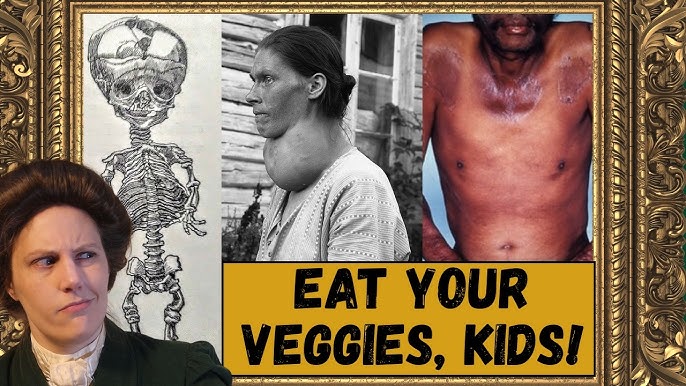
What if we told you that diseases which killed millions of people were cured by eating an orange, adding something to table salt, or simply not removing part of a grain? In this video, we’re diving into the most horrific nutritional deficiencies in human history.
Horrific Nutritional Deficiencies We (Thankfully) Don’t See Anymore
What if I told you that we used to have common medical conditions that would make your old childhood scars spontaneously rip back open? Or that there were illnesses that killed thousands of people every year that we now completely prevent with… table salt?
We’re talking about severe nutritional deficiencies. These were conditions that used to be absolute death sentences, but are now so rare that most modern doctors will never see a single case in their entire career. And the wild part? We didn’t cure them with fancy, groundbreaking medicine. We mostly stumbled into the solutions by accident.
Here is the thing about nutritional deficiencies: they are historical proof that for most of human existence, we had absolutely no idea what we were doing when it came to food. We knew we needed to eat to survive, but we didn’t understand that specific nutrients were doing specific, vital jobs inside our bodies.
For centuries, civilizations consumed baseline diets completely unaware of the vital micro-compounds keeping their cellular architecture intact.
People would follow perfectly reasonable dietary practices—like polishing rice to make it prettier, or eating only preserved foods on long sea voyages—and then mysteriously start dying in horrific ways. The diseases we’re about to discuss killed millions of people and devastated populations. Yet, they were entirely preventable with food that was often sitting right there.
Want to watch the full video analysis? Don’t forget to subscribe to the channel for new death-related content every Friday!
1. Scurvy: When Your Body Literally Falls Apart
Let’s start with scurvy, because it’s probably the most famous on this list, and for good reason—it’s an absolute nightmare. Scurvy is caused by a lack of Vitamin C. Your body desperately needs Vitamin C to make collagen, which is basically the biological glue that holds you together. Without it, that glue starts to dissolve:
Your gums turn black and spongy.
Your teeth fall out.
You develop massive bruises as blood vessels rupture under your skin.
The baseline solution to maritime scurvy was incredibly simple, yet millions perished before the medical establishment made citrus rations standard protocol.
But here’s the truly horrifying bit: in advanced cases of scurvy, old wounds and scars—injuries that healed years ago—spontaneously break back open. Your body is literally unmaking repairs it did in the past because it no longer has the materials to maintain them.
Scurvy was the bastard of all maritime diseases. Ships would leave port with full crews and arrive with half the men dead. It’s estimated to have killed two million sailors between 1500 and 1800.
The cure? Citrus fruit. Lemons, limes, oranges. British naval surgeon James Lind even proved it worked in 1747 with one of the first controlled clinical trials in history. But the British Navy didn’t make citrus juice mandatory until 1795—nearly 50 years later.
2. Rickets: When Your Bones Forget How to Bone
Rickets is what happens when children don’t get enough Vitamin D. Vitamin D helps your body absorb calcium, and calcium makes bones hard. Without it, children’s bones stay soft and bendy, leading to bowed legs, knock knees, curved spines, and a string of bumps along the ribcage where the ribs actively deform.
Sunless industrial landscapes and indoor labor settings starved generation’s skeletal frames of essential solar synthesis.
This disease was absolutely rampant during the Industrial Revolution. Children worked 14-hour days indoors in factories and lived in cramped, sunless housing. Since your body makes Vitamin D from sunlight, these kids were starving for it. In Victorian England, bowed legs were just considered “normal” for working-class children.
The solution ended up being elegantly simple: fortify milk with Vitamin D. This started in the 1930s, and rickets cases plummeted. We literally just added the vitamin to something kids were already drinking.
Navigating Crucial Medical or Care Directives?
Get supportive, highly practical, and completely non-judgmental guidance on individual end-of-life pathways, advanced health directives, and strategic care support systems.
Pellagra is caused by a lack of Niacin (Vitamin B3), and it was epidemic in the American South in the early 1900s. It was known as the disease of the “Four Ds”:
Dermatitis: A symmetrical, burn-like rash on sun-exposed skin that would darken, crack, and peel.
Diarrhoea: Relentless and bloody.
Dementia: Confusion, hallucinations, aggression, and eventually complete psychosis.
Death: Usually within four to five years of the first symptoms.
Diets heavy in untreated corn meal locked vital niacin vitamins behind unabsorbable molecular configurations, initiating widespread system failures.
For years, doctors thought pellagra was an infectious disease. They looked for bacteria while people were literally just starving for a specific nutrient. Poor Southern families subsisted almost entirely on cornmeal, salt pork, and molasses. While corn does contain niacin, humans can’t absorb it unless the corn is treated with an alkali (like in traditional Mexican nixtamalisation).
In 1915, Dr. Joseph Goldberger proved it was a dietary issue through a series of experiments that would never pass an ethics review today—he literally induced pellagra in prison volunteers, then cured them by adding meat and vegetables to their diet. By the 1940s, we started enriching flour and cornmeal with niacin, and the disease essentially vanished within a decade.
4. Beriberi: The Rice That Killed Millions
Beriberi is what happens when you polish your rice to make it look fancier and accidentally remove all the Thiamine (Vitamin B1). There are two main types, and both are miserable:
Wet Beriberi: Causes heart failure and severe swelling.
Dry Beriberi: Destroys your nervous system, leading to muscle wasting and paralysis.
Industrialized machinery allowed communities to polish rice into cleaner, visual presentations—unknowingly processing away their main source of neurological defense.
Beriberi became a massive problem in Asia in the late 1800s when industrial milling allowed for the mass production of white rice. Brown rice has thiamine in its outer layers, but polishing it off strips the nutrition. Populations that had eaten rice safely for thousands of years suddenly faced an epidemic.
The Japanese Navy lost thousands of sailors to beriberi in the 1880s until a naval doctor figured out the diet connection and added meat and barley to their rations. Once we figured out that we just needed to either enrich white rice or leave the bran on, the epidemic ended.
5. Goitre: The Iodine Solution
Finally, let’s talk about goitre. This is what happens when your thyroid gland swells up to massive proportions because it’s desperately trying to function without enough Iodine.
Your thyroid needs iodine to make hormones that regulate your metabolism. Without it, the gland enlarges into growths the size of grapefruits on the neck. Severe iodine deficiency also caused cretinism—stunted growth and severe intellectual disability in children.
By simply blending trace iodine levels into universal table condiments, societies easily erased a thousands-of-years-old neurological crisis.
Goitre was incredibly common in inland areas far from the ocean (like the Alps or the Great Lakes), where soil and water naturally lack iodine. Entire villages had swollen necks, and it was just accepted as a fact of life. The cure? Add iodine to table salt.
Switzerland started iodising salt in 1922. The US followed in 1924. Within a few years, goitre rates plummeted. A problem that had plagued humanity since the beginning of recorded history was essentially eliminated by slightly modifying a standard table condiment.
The Accidental Cures
Here is what is truly wild about these diseases: they killed millions of people, disabled children, and depopulated entire regions. But we didn’t defeat them with groundbreaking surgeries, radiation, or miracle drugs. We defeated them by accident. By trial and error. By simply adding things to the food we were already eating.
Scurvy? Eat an orange. Rickets? Drink fortified milk. Goitre? Use iodised salt.
These solutions seem incredibly obvious to us now, but it took humanity thousands of years and millions of deaths to figure out that food is more than just fuel. It makes you wonder: It’s easy to look at modern diseases like cancer, heart disease, or Alzheimer’s and assume they’re just an inevitable part of the human condition. But scurvy and pellagra were once considered mysterious and inevitable, too. We didn’t cure these nutritional deficiencies—we prevented them.
What modern conditions that we accept as “just part of life” might actually be preventable with knowledge we just haven’t connected yet?
Practical Brand Tools & Resources
Equip yourself and your family with organized frameworks before a crisis limits your choices.
Advance Care Workbook
Clear, direct, step-by-step guidance to formally map and secure your personal wishes.
Every summer, Australia lights up like a giant barbecue that no one asked for. Millions of hectares gone, animals dead, towns wiped off the map, with the Kiwi and Canadian Fire Departments flying in to help. It’s a very reliable, if unfortunate, summer playbook over here. So, why does Australia so reliably go up in flames every year?
If you’ve just found this channel, welcome. We post death-related videos every Friday, looking at it from every angle with Aussie sarcasm. So, if that sounds like your kind of thing, consider subscribing to the channel. Now, let’s talk Aussie bushfires.
Why Australia Burns
Australia is the most fire-prone country on Earth. And that’s not hyperbole. That’s just the continent doing what it was built to do.
Three things have to line up for a catastrophic fire: fuel, heat, and wind. Australia has all three in abundance, and simultaneously. The fuel is Australian vegetation, particularly eucalyptus, which produces a flammable oil that makes it essentially nature’s firelighter. Leaf litter, peeling bark, and dry undergrowth—it all piles up between burns.
Eucalyptus leaves contain highly volatile, flammable oils that turn dry forests into ticking ecological time bombs.
The heat comes from a climate that is structurally one of the hottest and driest. And the wind—Australia is ringed by wind systems that push hot, dry air across the interior and funnel it straight into populated coastal areas. The country has always been this way, but climate change has made all three things worse.
Australia has warmed around 1.5°C since 1910, with most of that warming since 1950. The number of days above 35°C has increased significantly. Droughts are longer. The fire season has extended into autumn. The window for safe hazard reduction burns is shrinking. But here’s the thing: the Australian landscape didn’t evolve to resist fire. It evolved with fire. And for at least 80,000 years, Indigenous Australians understood that distinction completely.
Built to Burn
Before we get on to the disasters, let’s talk about what fire actually means to this continent. Because Australia’s plants and animals don’t just survive fire—many of them depend on it.
Eucalyptus trees have epicormic buds buried under their bark—dormant growth points that activate the moment a fire passes. Within weeks of a burn, the scorched gum tree is already pushing out fresh green shoots. It doesn’t wait to recover; it’s already preparing for the next fire. Banksias go further: their seed pods are sealed so tight that only the heat of a bushfire can open them. Some have held on to seeds for years, waiting. The moment fire rips through, the cone splits, seeds rain onto the freshly cleared ash bed, and a new generation has the best possible start because all the competition burnt. Wattles do something similar.
Within weeks of an intense burn, many native Australian trees push out vibrant epicormic growth directly from their scorched trunks.
The smoke itself contains chemicals that trigger germination in dozens of native species. The fire is essentially the signal that says, “Now is your moment.” Grass trees, those weird prehistoric-looking things with the long black trunks, only flower after fire. Some native orchids only appear in the year after a burn. The entire understory of much of Australia’s bush is a coiled spring waiting for a match.
Animals have adapted too. Sugar gliders, kookaburras, and owls survive fires sheltered inside tree hollows. Wombats and reptiles ride it out underground. Kangaroos move towards fresh post-fire growth within days. The new shoots emerge from ash beds and are exactly what they want. Birds of prey have even been observed deliberately carrying burning sticks from one fire to a new area to flush out prey. We’ve known about this behavior from Aboriginal oral tradition for generations, and scientists confirmed it formally in 2018. The ecosystem isn’t broken by fire at the right frequency. It is refreshed by it.
The problem has never been fire itself. The problem is fire at the wrong scale, the wrong season, and the wrong intensity.
Which is exactly what happens when you spend 200 years preventing the small burns that were keeping the big ones manageable.
Navigating Emergency or Care Contingencies?
Get factual, non-judgmental, and practical advisory support on crisis planning, Advanced Care Directives, and system literacy before a transition forces your hand.
Aboriginal Australians didn’t just live in a fire-prone landscape; they actively shaped it using fire as a tool—a practice known as cultural burning or cool burning that was in continuous use for well over 60,000 years. The method is precise in a way that bureaucratic hazard reduction burns simply aren’t.
Cultural burns are small, low, cool fires lit at specific times, typically early in the dry season from around April to July, when overnight dew keeps the temperatures down and winds are gentle. They don’t touch the canopy; the canopy is left intact deliberately. It provides shelter and seeds for the next generation. What burns is the undergrowth, the bracken, the dead grass, and the accumulated leaf litter that would otherwise become fuel for a catastrophic fire.
Traditional fire-stick farming practices created a managed mosaic of open country that historically prevented large-scale canopy firestorms.
The timing isn’t guesswork. Aboriginal knowledge holders read the landscape—when certain trees flowered, or when native grasses cured—to know exactly when to burn and when not to. As an Aboriginal community member put it: “The knowledge is held within the landscape. Once we learn how to read the landscape and interpret that knowledge, that’s when we apply those fire practices.”
The result was a mosaic. Patches of burnt and unburnt country in rotation, creating a patchwork of habitats that supported maximum biodiversity, controlled fuel loads, and made catastrophic fire essentially impossible at scale. Early European settlers described the landscape as looking like a park—open, grassy, and park-like—because it had been actively maintained that way for millennia.
When colonization forced Aboriginal people off their land and suppressed burning practices, that mosaic quickly fell apart. Fuel built up unchecked. The landscape Europeans protected from small fires was loading itself for enormous ones. A 2001 study found that the disruption of traditional burning directly increased the risk of extensive, uncontrolled wildfires across Australia. A 2017 study found that the removal of mature trees by European settlers triggered dense regrowth that created a far greater fire fuel hazard than existed before.
In the desert territory where traditional burning stopped in the 1950s and 1960s, subsequent uncontrolled fires destroyed vast, sweeping tracts of tens of thousands of square kilometers in just a couple of seasons. That’s the cost of ignoring 60,000 years of expertise.
The good news, if there is any, is that cultural burning is making a comeback. Dozens of Indigenous-owned fire management projects are operating across millions of hectares in northern Australia, abating around one million tons of carbon emissions per year. The land is being listened to again. Whether it’s happening fast enough is a different question. You can’t stop fire in Australia—you can only manage it, or ignore it until it manages you.
Australia’s Deadliest Hits: Black Summer & Beyond
Australia’s deadliest bushfires read like a greatest hits album that no one wanted to release.
Black Friday (1939, Victoria): Temperatures in Melbourne hit 44.7°C. Fires tore through two million hectares, obliterated entire towns like Narbethong and Noojee, and killed 71 people. A royal commission followed.
Ash Wednesday (1983, Victoria and South Australia): 75 dead, nearly 1,900 homes destroyed, and 104 fires burning simultaneously by a single morning. The energy released was reportedly equivalent to 1,500 Hiroshima-style bombs.
Black Saturday (2009, Victoria): The single deadliest fire event in Australian history. 173 people killed. Over 430,000 hectares burned, more than 2,000 homes gone, and almost 80 communities left unrecognizable. Melbourne had experienced three consecutive days above 43°C beforehand—the first time that was ever recorded.
The historic 2019-2020 Black Summer fires incinerated over 24 million hectares, emitting more than 700 million tons of carbon.
Then came the Black Summer of 2019 to 2020, the worst fire season on record. Full stop. Over 24 million hectares burnt, and 33 people were killed directly. Smoke from the fires was responsible for an additional 417 deaths. An estimated 3 billion animals were killed or displaced. We lost 70% of the koala population from those areas. The air quality in Canberra on New Year’s Day in 2020 was the worst of any city on the planet. The fires generated their own weather systems—fire tornadoes, lightning, and pyroconvective storms.
People outside of Australia struggle to grasp the scale. In 1974 to 1975, fires burnt between 100 and 117 million hectares across central Australia—roughly 15% of the entire continent. That’s an area the size of France and Spain combined. Three people died, largely because nobody lives out there. The Black Summer fires burned 24 million hectares. For context, the entire Amazon lost 10 million hectares in fires in 2019 and the world lost its mind. Australia lost more than twice that in a single season in a country with a modest population.
The reason Australia doesn’t always top the global human death toll despite burning such enormous areas is geography. Most of what burns is remote scrub and grassland. When fire hits the urban fringes—the outer suburbs of Melbourne, or the holiday towns of the New South Wales South Coast—that’s when people die.
The “Death Tree” We Sent to America
Here’s where it gets interesting for our US viewers, and where Australians can either feel smug or guilty depending on your outlook. When Los Angeles burned in January 2025, killing dozens and destroying over 12,000 structures, one question kept surfacing: What role did eucalyptus play?
The tree most responsible for Australia’s fire problem is now all over California, and the path it took to get there is pretty wild. A German-born botanist named Ferdinand von Mueller immigrated to Australia and became completely obsessed with eucalyptus. He spent decades evangelicalizing these trees, writing books, corresponding with botanists globally, and mailing seeds all over the world. It was essentially the apple seed of an ecological catastrophe.
Imported during the Gold Rush era, fast-growing Australian Blue Gums now carpet large swaths of residential California.
By the 1850s, eucalyptus seeds were arriving in California during the Gold Rush. California authorities, desperate for timber after clearing most of the native trees, encouraged mass planting. By the early 1900s, thousands of acres of eucalyptus, mostly Tasmanian Blue Gum, covered the hills of Southern California.
The problem is that eucalyptus is not a passive resident. It produces a flammable oil that has been tested as a fuel substitute. Its bark peels off in long strips that fall to the ground and act as pure kindling. Its leaves build up in dense, dry carpets. When a fire starts near the eucalyptus canopy, the oil vaporizes, the bark channels the flames upward, and burning embers can be blown over a kilometer downwind to ignite new fires. The 1991 Oakland Hills firestorm, which killed 25 people and destroyed over 3,000 homes, was fueled in part by heavy eucalyptus groves. The debate re-erupted after every subsequent California fire.
Now, to be fair—and this matters—experts are divided on how much blame eucalyptus actually deserves. As a fire ecologist put it plainly: “Blaming eucalyptus for wildfires is a bit like blaming a match for starting a fire.” California’s native chaparral is also highly flammable. The fierce Santa Ana winds would turn almost anything into an inferno. And then there’s the houses themselves. Most American homes, regardless of how much they cost, are built from timber frames. A million-dollar Malibu mansion burns just as fast as a cheap kit home if the walls are wood. In Australia, brick veneer or double-brick construction is standard. It’s not perfect, but it buys time.
Americans build their dream homes out of kindling, plant them next to fire-adapted Australian trees, and then act surprised when everything burns.
But here’s the kicker: eucalyptus doesn’t just burn; it thrives after burning. When a fire scorches an area, eucalyptus regenerates rapidly and outcompetes everything else. Burn a hillside, and the eucalyptus comes back dominant. It has literally evolved to use fire as a competitive advantage. There’s really no getting rid of it. That’s fine in Australia where the whole ecosystem is built around it. In California, where native species haven’t adapted to handle that specific fuel profile, it’s a completely different story. So, Australia didn’t deliberately export its fire problem, but it did accidentally export the plant most responsible for it for financial gain. And that plant is now embedded in one of the most fire-prone landscapes on Earth, waiting for the next major wind event.
How to Actually Survive the Heat
Australia burns because it was always going to burn. The continent’s climate, vegetation, and geography make fire inevitable. What’s changed is the scale, the frequency, and the season length—and all of those are moving rapidly in the wrong direction.
The Black Summer was a preview, not a peak. Public scientists state that conditions like those of 2019 will become more common, not less. And eucalyptus is now on every occupied continent on Earth. One researcher summarized it succinctly: “What the hell have humans done? We’ve spread a dangerous plant all over the world.”
So, here’s the question for you: When a disaster is both completely natural and entirely made worse by human decisions, who is responsible? And does it really matter when the fire is already at your front door?
Let’s talk death.
Practical Death Literacy Tools
Equip yourself and your family with organized frameworks before a crisis limits your choices.
Advance Care Workbook
Step-by-step professional guidance for cleanly and legally documenting your final medical and personal wishes.
Australia has a reputation for being a total death trap. Sharks, crocs, spiders, snakes. Tourists arrive half-expecting to be eaten the moment they step off the tarmac. But here’s the thing: the animals that Australians actually fear the most are almost never the ones doing the killing. The animals that actually kill us are embarrassingly mundane.
We post death-related videos every Friday, so if that sounds like your kind of thing, consider subscribing to the channel. Now, let’s talk deadly Australian animals.
Australia has more venomous species than anywhere else on Earth. That’s not a myth. But “venomous” and “deadly” aren’t necessarily the same thing. And somewhere along the way, people started to confuse sheer, visceral fear with actual statistical risk.
So today, we’re running the two lists side by side—the most feared, and the actual killers—and seeing how badly you’ve all been misled.
The Most Feared (What Tourists Think Will Kill Them)
Ask most international visitors to name Australia’s deadliest animals, and you’ll get a very predictable list. Sharks, crocs, box jellyfish, funnel-web spiders, eastern brown snakes, blue-ringed octopuses, stonefish, redback spiders, tiger snakes, cassowaries.
On paper, fair enough. These animals are genuinely dangerous. Some have venom that can kill in minutes. Some have enough bite force to remove a limb. A cassowary can kick you open like a can opener.
The international fear list is loaded with apex predators, but the actual fatality statistics tell a very different story.
And yet, in any given year, how many Australians do these animals actually kill?
Sharks: Around 2 to 4 fatal attacks annually.
Crocs: 1 to 2.
Box Jellyfish: Maybe 2.
Funnel-Web Spiders: Zero. The last recorded death was in 1981, before antivenom existed.
Eastern Brown Snakes: 2 to 4.
Blue-Ringed Octopus: 2 confirmed deaths in Australia’s colonial history.
Stonefish: Zero recorded Australian fatalities in modern records.
Redback Spiders: Zero since antivenom.
Cassowaries: One confirmed human death ever, in 1926.
Snakes as a whole account for roughly 2 to 4 deaths per year across all species combined. That’s it.
You are more likely to be killed by stubbing your toe and cracking your skull on a barbecue.
What Australians Actually Fear
Here’s the thing about the tourist fear list: it was written by people who don’t actually live here. Ask any actual Australian what animal makes their blood run cold, and you’ll get a very different answer.
Magpies
Every Australian has a magpie story. From August to November, “swooping season” turns suburban streets into an absolute gauntlet. These birds are intelligent, territorial, and they remember faces—specifically your face—and they will find you again.
Swooping season causes genuine injuries every year and turns suburban streets into a daily survival gauntlet.
Cyclists wear zip ties pointing out of their helmets. Parents walk kids to school with their arms raised. The website Magpie Alert logged over 3,500 attacks in a single season. People have lost eyes. A toddler in Queensland died in 2021 after being startled by a swooping magpie and falling.
They’re no joke, and they are a serious scheduling problem. And yet, outside of those months, they’re actually lovely creatures. (Swooping plovers and butcher birds also get an honorable mention. Same energy, smaller fan base.)
Drop Bears
Yes, the drop bears. But firstly, they don’t live in the cities. I don’t know why international folks think that. Much like koalas, they live in trees, and there aren’t many trees in cities.
They are a big problem for bushwalkers and those living in bushland regions because they live up in the canopies and drop onto prey from a height. Locals know to look up when they stop to rest. Tourists don’t. The official advice is to spread Vegemite behind your ears or on your nose as a deterrent. The strong aroma is usually enough to keep them away.
Huntsman Spiders & Bin Chickens
Next are Huntsman spiders, who don’t make the international fear list because they’re not particularly venomous. They make the Australian fear list because one will appear on your car’s sun visor when you’re going 100 km/h down the highway, and you will drive straight into a ditch. Cause of death? Technically the ditch. Morally? The spider.
And finally, “bin chickens” (the Australian White Ibis). Nobody fears them, and yet they are everywhere, and they are bold, and they will take food directly from your hand with the dead-eyed confidence of something that has fully abandoned the social contract. No recorded fatalities yet, but it does feel like only a matter of time.
Navigating Real-Life Health & End-of-Life Risks?
Get factual, supportive, and highly practical guidance from Sam on medical frameworks, Advanced Care Directives, and navigating unexpected health transitions.
The Actual Killers (What’s Putting Us in the Ground)
So, if it’s not the animals on the tourism posters, what’s actually putting Australians in the ground? It reads like a rural insurance claim, not a wildlife documentary.
Horses & Cattle
Horses kill more Australians per year than any other animal—around 5 on average, mostly from falls or being thrown. They are in every state, ridden by people of all ages, and they weigh half a ton.
We regulate car seats for children, but put kids on a thousand-kilo animal with minimal safety gear and call it character building.
We have normalized the risk entirely. Helmets are compulsory in some venues and optional in others. We regulate car seats for children, but put kids on a thousand-kilo animal with minimal safety gear and call it character building.
Cattle produce similar numbers: kicks, crushes, trampling. Farmers and rodeo workers are particularly exposed, and absolutely no one is making a dramatic documentary series about that.
Bees, Wasps & Dogs
Bees and wasps account for around 2 to 5 deaths annually from anaphylactic shock. Anaphylaxis is the great equalizer. An insect the size of a thumbnail can kill a full-grown adult in under half an hour. Allergic reactions are completely unpredictable. You can be stung 50 times without any incident and die on the 51st sting. People with known allergies routinely don’t carry their EpiPens. That’s a fixable problem that we mostly just haven’t fixed.
Dogs account for 1 to 2 deaths per year, mostly children. Australia euthanizes tens of thousands of dogs annually for aggression, and we still lose people. Go figure.
Kangaroos (Letting Physics Do the Rest)
Kangaroos don’t usually rack up fatalities from direct attacks, but from car collisions. They cause hundreds of accidents a year and multiple deaths.
The roo doesn’t mean to kill you. It just exists at exactly bonnet height on a dark road and stares into your headlights with complete philosophical detachment.
The roo doesn’t mean to kill you. It just exists at exactly bonnet height on a dark road, stares into your headlights with complete philosophical detachment, and lets physics do the rest.
And before you feel too sorry for them, a large male red kangaroo stands at 2 meters tall, weighs 90 kilos, and can disembowel a dog with one kick. They’re not helpless. They’ve just decided that cars aren’t worth the effort.
The Stingray Beef & The Great Emu War
Stingrays are not on anyone’s fear list. They’re flat. They’re shy. They spend most of their time doing nothing on the seafloor. Globally, fatal stingray strikes are extraordinarily rare.
And then in 2006, one of them took out Steve Irwin, the one man on Earth who seemed genuinely unkillable. A bloke who wrestled crocodiles for fun and treated venomous snakes like a mildly rude house guest… gone to a stingray. Australia has had a beef with the stingray ever since. It’s tense. We’re currently in negotiations, but nothing’s been resolved. And frankly, the stingray doesn’t seem to be all that interested in a settlement.
And where to start with the Emus? They can’t fly. They have no natural predators in Australia. They are essentially large, aggressive feather tubes with the problem-solving ability of a middle manager and absolutely no fear of consequences. They mostly cause property damage and vehicle collisions rather than direct fatalities.
But in 1932, the Australian government decided that enough was enough and deployed actual soldiers with machine guns to cull them. The emus won decisively. The military withdrew in embarrassment after 11 days. So naturally, in 1948, Australia tried again. Same result. We lost to the same bloody bird twice with guns.
The emus have never acknowledged the conflict. They were just standing around being emus, and two separate governments declared war on them, and both went home quietly. They have been here long before people, and they’ll be here long after we’re gone, standing in the middle of the road, staring at nothing, completely unbothered.
Why Are We So Wrong?
This isn’t accidental. Our brains are wired to fear things that *look* dangerous. Things with fangs, venom, and prehistoric menace. There’s even a psychological concept for it: we judge the likelihood of something by how easily an example comes to mind.
Shark attacks are constantly in the headlines. “Man thrown from horse” makes page 12 in the local newspaper.
The tourism industry hasn’t helped. “Australia, where everything wants to kill you” runs itself as a marketing line. Every international travel article lists the funnel-web spider, the eastern brown, the box jellyfish. No one’s clicking on a story about bees.
Media logic does the rest. A crocodile death is a massive story. A horse riding accident is a tragedy, but it doesn’t go viral. So, the crocodile ends up with the lethal reputation, and the horse wins a ribbon at the Royal Easter Show.
The Animals That Actually Deserve More Respect
The Eastern Brown snake genuinely earns its reputation. It’s responsible for more snakebite deaths than any other species in Australia. It’s common in both suburban and rural areas. It’s fast, and unlike many snakes, it doesn’t retreat. It escalates. If there’s one animal on the feared list that belongs there, it’s this one.
Bees and wasps deserve dramatically more caution than they get. Your first anaphylactic reaction will happen without warning.
Magpies deserve formal recognition as a public health issue. Swooping season causes real injuries every year and receives about the same institutional attention as a minor pothole. Meanwhile, there are national strategies for an animal that hasn’t killed anyone since the 1920s.
And the drop bear… look, all we’re saying is: Vegemite behind the ears. Don’t look up into the canopy for too long. And if you hear something move in the gum trees above you, walk. Don’t run. Running will trigger the instinct.
The gap between the animals we fear and the animals that actually kill us is enormous. And it’s not random. It’s a product of how dramatic something looks versus how often it actually causes harm.
Snakes look like death. Horses look like pets. Bees look like, well, bees. And magpies look like a bird until it takes your eye out on the way to work.
None of this means you should be swimming with sharks or handling an Eastern Brown. Respect the dangerous ones. But if you spend time around horses, cattle, bees, or—and we cannot stress this enough—if you travel through magpie territory between August and November during a holiday, that’s where your caution should actually live.
So here’s the question for the comments: Which animal do you think gets the least respect but is an actual genuine threat? Drop it below.
Let’s talk death.
Practical Death Literacy Tools
Equip yourself and your family with organized frameworks before a crisis limits your choices.
Advance Care Workbook
Step-by-step professional guidance for cleanly and legally documenting your final medical and personal wishes.
In today’s world, the West loves to complain about the funeral industry taking their money, and they love to act smart with their “funerals are pointless anyway” remarks. Both points fall apart with 30 seconds of critical thinking outside the death avoidance bubble our society has created.
<
title=”The Lie of the Pointless Funeral” allow=”accelerometer; autoplay; clipboard-write; encrypted-media; gyroscope; picture-in-picture” allowfullscreen=””>
For those of you who have just found us, welcome to Taboo Education. We post videos every Friday looking at death from every possible angle. So, if that sounds like your cup of tea, consider subscribing to the channel.
Instead, the West has decided that since funerals are pointless, we’ll create the “celebration of life” instead. These upbeat, no-one-is-allowed-to-be-sad, everything-bright-colors funeral replacements are the reasons why you feel funerals are pointless. So, let’s take a look at what funerals were actually supposed to do, why you refuse to do it, and why celebrations of life are soulless, death-avoidant black holes that are actually horrible for your wellbeing.
What is a Funeral Actually For?
Before asking what’s gone wrong with funerals, it’s worth asking what they were always supposed to do. The answer is not, despite persistent cynicism, primarily to generate revenue for an industry. We actually have a video about that. That critique, while not entirely without merit, is simply an easy scapegoat.
Funerals predate the funeral industry by millennia. Every human culture in recorded history has had them, in forms ranging from the elaborate to the minimal, but present nonetheless. That kind of universality suggests a funeral is meeting a need that is genuinely human.
A funeral gathers the community, signaling that a loss is a collective event and not merely a private one.
A funeral does several things at once. It marks the reality of the death, making it concrete and undeniable for the people who love the deceased. It gathers the community, signaling that a loss is a collective event and not merely a private one. It gives the bereaved a structured role to occupy at the moment when they are feeling disorientated, so that the body knows what to do even when the mind cannot function.
And importantly, it opens a sanctioned space for grief. A place and a time where weeping, wailing, and visible sorrow are not just permitted, but expected.
The ritual does not create the grief. The grief was already there. The ritual simply gives it somewhere to go. This last function is perhaps the most important and the most underappreciated. Human beings need permission to feel their feelings in public. The funeral is one of the few remaining social occasions where grief is the correct response. Where breaking down is not an overreaction, but an entirely proportionate one.
When the ritual is working as it should, the mourner is held by the community and by the structure of the occasion itself. They are not alone in their loss. The community has shown up, and the form of the gathering tells everyone present what their role is: to bear witness, to stay close, and to absorb some of the weight.
Navigating End-of-Life Planning?
Get supportive, highly practical, and completely non-judgmental guidance on individual end-of-life pathways, navigating grief, and making informed decisions when it matters most.
The celebration of life did not emerge out of nowhere. It is the latest expression of a cultural tendency that has been building in the West for over a century.
The historian Philippe Ariès traced this arc in detail, describing how Western attitudes towards death shifted from what he calls the “tame death” of the medieval period—accepted, public, and communal—towards what he termed the “invisible death” of the modern day, in which dying is hidden in hospitals, grief is privatized, and death itself is treated as something between an embarrassment and a failure.
Ernest Becker argued that much of human culture is an elaborate, unconscious defense against the terror of our own mortality.
Ernest Becker, writing The Denial of Death in 1973, went further, arguing that much of human culture is an elaborate and largely unconscious defense against the terror of our own mortality. We build civilizations, leave legacies, follow religions, and construct meaning precisely because we cannot bear to sit with the knowledge that we will die.
The problem with defenses, as any psychologist will note, is that they work in the short term and accumulate cost over time. A society that has become very good at not thinking about death does not suffer any less grief. It simply suffers it less well.
The celebration of life is a near-perfect expression of this tendency. The language alone is doing a vast amount of work. “Celebration of life” orientates attention towards the past, towards the fact that someone once lived, away from the present, the fact that they have died.
Death gets mentioned as little as possible. The word “funeral” is increasingly avoided, as if it carries some sort of contagion. The result is a ceremony that gestures at loss while systematically refusing to look directly at it.
The Problem with Positivity and “No Crying”
There is a specific instruction that has become common in recent decades, issued in advance by the aging or dying and dutifully honored by those left behind. And it goes something like: “No sad faces at my funeral. Bright colors only. I want people to celebrate, not mourn.”
The instinct behind this is almost always kind. People do not want to cause pain. They do not want to be remembered in an atmosphere of misery. They want to be associated with joy. But the instruction, however lovingly intended, contains several problems worth examining.
The first is that it tries to author an experience for people who are in the middle of their own horrible experience. The mourners at a funeral are not there to perform the deceased’s preferred self-image. They are there because they’re in pain, because someone they loved is gone, and because they need a space to acknowledge that.
When the deceased has issued instructions about the emotional tone of the occasion, the mourners are placed in an impossible position. If they cry, they feel they have violated the wishes of the person they are grieving. Even though that person is rotting in a box right in front of them and ain’t coming back to complain, they are managing the guilt on top of the grief, which is a remarkable burden to place on someone in the acute phase of loss.
You do not cry at a funeral because you have decided to. You cry because someone you love is gone and your body knows it before your mind can catch up.
The second problem is that grief is not a choice. When someone asks you not to cry at their funeral, they are asking you to suppress the involuntary physiological and emotional response to one of the worst experiences of your life. The instruction mistakes grief for a performance when it is, in fact, a reflex—the body’s honest response to loss.
The third problem is that the “no crying” directive is almost certainly encoding something the person issuing it had not quite fully examined. There is guilt in that. The fear of having burdened the mourners with their grief. There is an identity in it. The desire to be remembered as someone joyful and light rather than heavy. And there is, underneath both of those, a confrontation with mortality that the person could not quite complete.
The thought of a room full of weeping people and a coffin, a procession, the full weight of the ritual is confronting precisely because it makes death feel real and final and significant. A party is easier to imagine. So the instruction is partly issued to comfort the dying person themselves, a way of making their own death more bearable to contemplate.
Celebration vs. True Mourning
It is important to be clear that joy and grief are not opposites, and that a genuinely mourning funeral can contain both.
The Irish wake, the New Orleans jazz funeral, the raucous storytelling that follows a burial in many cultures—these are not failures of mourning. They are expressions of it. Laughter at a wake is real laughter, but it grows out of grief. Everyone in the room knows why they are there. The sorrow is the water they are swimming in. And the joy is what occasionally breaks through it.
That is a very different thing from a ceremony designed to skip the swimming altogether and go straight to the fun.
The celebration of life often attempts exactly that skip. It reaches for the uplift without earning it through the genuine reckoning of the loss. The result is an occasion that can feel for many mourners vaguely fraudulent.
Standing in bright clothing holding a glass of something sparkling while feeling your grief has nowhere to go creates a vaguely fraudulent experience.
They are standing in a room full of people in bright clothing, holding a glass of something sparkling, listening to the deceased’s favorite playlist and feeling their grief with nowhere to put it. The ritual has not made space for what they are actually experiencing. It has, with the best of intentions, closed that space off.
This matters because grief with no container doesn’t disappear. It relocates. Research on bereavement consistently finds that suppressed or unexpressed grief tends to resurface later, often in ways that are harder to recognize and address. The mourning ritual that looks grim from the outside is doing real psychological work. It is giving grief somewhere to go in the presence of a community, which is the condition under which human beings have always processed loss the most effectively.
The Collapse of Communal Grief
Underneath all of this lies something that rarely gets named directly, but is felt by almost everyone that has attended a modern funeral: We no longer know what to do with a grieving person.
For most of human history, communities carried inherent wisdom about how to sit with loss. You stayed. You brought food. You did not try to fix it, or reframe it, or find the silver lining. You simply remained present in the grief with the person who was suffering with it.
Mourning periods had structures, often lengthy ones, that told the community how long to stay close and signaled to the bereaved that their loss was socially recognized and supported. The Jewish shiva, the wearing of black for a year, the formal period of mourning observed across many cultures. These are not arbitrary customs. They are technologies for managing collective grief, developed and refined over generations.
Most of that inherited structure has been dismantled by the secular West, and nothing has replaced it. What remains is a profound social awkwardness around grief. People genuinely do not know what to do or say.
The instinct is to comfort, to fix, to move the grieving person towards feeling better as quickly as possible because their pain is uncomfortable to witness, and there is no longer a shared script for simply being present in it.
“He’s in a better place.” “At least she didn’t suffer.” “You’ll get through this.”
All of these are ways to try and close the wound rather than acknowledge it, driven not by cruelty, but by helplessness.
The result is that a funeral where people are visibly and inconsolably grieving has become genuinely frightening to many mourners. Not because they don’t care, but because they have no idea what to do with it. The celebration of life format removes that risk. Everyone stays at a manageable emotional temperature. No one has to do the hard thing, which is to stay present with another person’s pain without trying to resolve it.
The Unspoken Rules of Modern Funerals
There is an unspoken set of rules operating in modern funerals. You do not cry too hard, and if you do cry, you recover quickly. Accept comfort graciously, and then signal that you’re all right. Do not make it too real for everyone else. Perform grief in a way that does not require anything of the people around you.
The ordinary social skill of simply being with someone who is suffering has quietly atrophied because we have decided it requires clinical expertise.
That is, when stated plainly, a remarkably cruel set of expectations to place on someone in the acute phase of loss. And yet, it operates almost invisibly, enforced not by anyone’s explicit intention, but by the collective discomfort of a community that has lost the ritual scaffolding and doesn’t know what to stand in its absence.
The therapeutic culture that surrounds grief has paradoxically made this worse in some respects. We live in an era that talks about mental health more than any of the previous generations and yet have less practical capacity to sit with another person’s pain than most cultures that preceded us.
We have professionalized grief. It belongs to therapists, counselors, and support groups. The ordinary social skill of simply being with someone who is suffering has quietly atrophied because we have decided it requires expertise. It requires someone else to do the work for us.
The community shows up for the funeral and then disperses, often with visible relief, leaving the bereaved to manage the real weight of it alone.
The Widow at Home Alone
This is the sharpest version of the argument and it’s worth stating without softening: A celebration of life is not a gift to the bereaved. It’s a gift to everyone else in the room.
Western culture has spent several decades celebrating individualism, teaching that community is optional, that your feelings are your business and other people’s feelings are their business. That is not merely a political or economic philosophy. It has seeped into the texture of everyday life, into what we feel we can reasonably ask of another person and what we feel obligated to give.
The answer, increasingly, is not very much.
We have quietly renegotiated the social contract around suffering downward to the point where showing up once, briefly, in brightly colored clothing, and then going home is considered adequate. It’s not adequate. It has never been adequate. But we have collectively agreed to pretend otherwise because the alternative asks something of us that we are no longer culturally equipped or willing to give. And then people complain that they’re lonely.
Consider what actually happens. Someone has just lost their partner. The person they built their entire life alongside. The person they slept next to, argued with, made plans to grow old together with. The absence is not just emotional. It is physical, spatial, domestic.
The house sounds different. The bed is wrong. There’s no one to tell things to.
Grief is not an event. It is a new permanent texture of every single day. The house sounds different. The bed is wrong.
The grief is not an event. It is a new permanent texture of every single day. And what does that person get? A party that they helped to plan and pay for, in colors they didn’t choose, for the comfort of the people who will drive home afterwards and not think about them again till Christmas.
Then they go home alone to a house that sounds different to deal with their pain alone.
That is a collective failure. Not anyone’s individual failure, but a failure of what we have decided a community means and what we are willing to do for one another.
The Ultimate Cost
The funeral industry does profit from grief, and that critique has merit, but it is also a distraction from something more uncomfortable. The celebration of life is not cheaper than a funeral in any meaningful sense. It still costs money, often a great deal of it.
What it purchases, additionally, is a curated experience of not-quite-grieving together. You pay for convenience. You’re paying, in other words, for an occasion carefully arranged to keep everyone emotionally safe.
The money is real. The function is not.
A genuine mourning ritual does not require significant expenditure. We’ve done a few videos on this on how to have an affordable funeral. No, it requires presence. It requires people staying. It requires the community absorbing some of the unbearable weight of loss by simply refusing to leave the bereaved person alone with it.
That costs nothing except time and the willingness to be uncomfortable, which is precisely why so many people no longer do it. We have decided without quite saying it that grief is the griever’s problem. Your loss belongs to you. It is your emotional event to manage, ideally with professional support, ideally without making too many demands of the people around you.
The community will come to the party, raise a glass, say “he would have wanted this,” and consider their obligation discharged.
But grief is not a private event. It never has been. The idea that it is historically bizarre, compulsory thin, and psychologically damaging. Loss happens to a person within a web of relationships. And whatever healing is possible happens within that same web.
It requires other people to stay close, to keep showing up, and to sit with difficulty without flinching. It requires a community to say with its actual physical presence over actual time that your loss matters to us and we’re not going anywhere.
A real mourning ritual is not comfortable. It asks you to look at death, to sit with someone in acute pain, and to stay where every social instinct tells you that you have done your bit and you can leave. It asks you to say nothing useful because there is nothing useful to say, and to be there anyway. It asks you to put your own discomfort aside for the need of someone who is suffering in a way that you probably cannot fully imagine.
That is genuinely hard.
And we have built an entire alternative ceremony whose primary function is to let us off the hook, dress it up in language of honoring the deceased and celebrating a life. But the deceased does not need honoring. The deceased is gone.
The person who needs something is the one who is still here, sitting in that house that sounds different, trying to understand how to live in a world that no longer contains the person they love the most.
The person who needs something is the one who is still here, trying to understand how to live in a world that no longer contains the person they love the most.
A funeral that flinches from the thing that it exists to address is not doing its job. The celebration of life is a kind gesture dressed up as a ritual. But kindness and ritual are not the same thing.
A ritual works because it is not optional, not personalized, not arranged to accommodate everyone’s comfort. It works because it is the same for everyone, because its forms are inherited rather than invented. And because it asks something of people who participate in it: it asks them to show up, to stay, to bear witness to loss together.
When it is replaced by an occasion designed to keep everyone comfortable, to celebrate rather than mourn, to look forward rather than directly at the fact of death, something is lost and is genuinely hard to recover.
The bereaved leaves without having been fully met in their grief. The community disperses without having done the work of collective mourning. And the death, the real event at the center of all of it, has been politely but firmly kept at arm’s length. This is why people think funerals are pointless.
Grief in its most general form is not a mental health diagnosis. It is not a weakness. It is not something to be managed or minimalized or redirected towards celebration. It is love with nowhere to go. And it deserves a ritual built specifically to receive it.
The funeral at its best and oldest was exactly that. What we have built in its place is something gentler, tidier, and considerably less useful.
And with that, go talk death.
Practical Death Literacy Tools
Equip yourself and your family with organized frameworks before a crisis limits your choices.
Advance Care Workbook
Step-by-step professional guidance for cleanly and legally documenting your final medical and personal wishes.
We are all aware of the rule in the Jehovah’s Witness faith about no blood transfusions. But do you know why? A few months ago, the religion made some big, unprecedented changes to this rule. So, while I’m updating you, let’s go through why they had this rule in the first place, how it has been changed recently, and why the medical community is opening their eyes now to the positives of their bloodless ways.
Origins of the Movement
Jehovah’s Witnesses originated near Pittsburgh, Pennsylvania, in the 1870s when Charles T. Russell formed a movement based on a literal millennialist interpretation of the Bible. From those early days, the movement cultivated a strong sense of separateness from mainstream society, distinguished by the belief that the world around it was morally compromised and spiritually corrupt.
From its inception, the movement cultivated a strong sense of theological separateness from secular, mainstream society.
The group relocated to Brooklyn, New York, in 1909 as it began to expand its organizational operations and publishing reach. Russell died in 1916 and was succeeded by Joseph F. Rutherford, a lawyer from Missouri who led the community through many of its early legal conflicts with the United States government until his death in 1942.
Rutherford’s tenure was formative in a deeper sense. He oversaw a period of intense persecution of witnesses who refused military service and other civic obligations, which pushed the organization to draw sharper boundaries between itself and secular society. It was precisely this atmosphere of persecution and internal consolidation that created the doctrinal conditions for the later emergence of the blood transfusion prohibition.
Witnesses had already developed a posture of conscientious objection to medical practices they considered pagan and contrary to scripture, including vaccinations. The blood doctrine that followed was not an isolated development, but an extension of this established pattern of resistance.
The 1945 Declaration: Birth of the Blood Doctrine
The first official statement on blood transfusions appeared in the Jehovah’s Witness official magazine, The Watchtower, on the 1st of July, 1945. It declared that blood transfusions were pagan and god-dishonoring. This was a pivotal and consequential moment.
The timing was not coincidental. The Second World War had dramatically expanded the use of blood transfusions in military medicine, making the procedure far more visible and widely discussed than it had ever been before. The Watchtower Society’s ruling can be understood partly as a response to that cultural moment, drawing a clear line between faithful witnesses and a world that had embraced what the organization considered a violation of divine law.
As medical technology advanced rapidly through the 20th century, the original blanket prohibition of whole blood had to be progressively refined.
Over the following decades, the doctrine had to evolve continuously to keep pace with the advances of medicine. The original blanket prohibition of whole blood was progressively refined as new technologies emerged, including blood fractionation, autologous transfusions (using one’s own stored blood), and synthetic blood substitutes. Each innovation forced the organization to make theological rulings about where exactly the line was to be drawn between acceptable and prohibited treatments.
The Biblical Basis
The doctrine rests on several key scriptural passages. Jehovah’s Witnesses draw primarily from Genesis 9:4, Leviticus 17:10, and Acts 15:28-29, interpreting these texts to mean that blood represents life itself and is sacred to God. They believe that once the blood has been removed from the body, the only divinely authorized use for it is in the atonement of sins.
The dietary logic runs from Genesis: “Only flesh with its life—its blood—you must not eat.”
Through Leviticus: “I will certainly set my face against the one who is eating the blood.”
With a reliance on Acts 15:28-29 being particularly significant, because it extends the prohibition beyond the Old Testament dietary laws directly into the Christian era.
A Watchtower article on the 1st of July 1951 made the critical leap, arguing that food and blood transfusions amount to the same thing insofar as both introduce substances into the body. Critics have long contested this reasoning, noting that digestion and intravenous transfusion are physiologically distinct processes, but the Watchtower Society held firm. Blood entering the body by any route was equally forbidden.
Navigating Crucial Medical or Care Directives?
Get supportive, highly practical, and completely non-judgmental guidance on individual end-of-life pathways, advanced health directives, and understanding your medical rights.
Jehovah’s Witnesses organize blood into four primary components: red cells, white cells, platelets, and plasma. Members are expressly forbidden from receiving transfusions of whole blood, any of these four components, or anything whose primary function corresponds to any of those primary components.
However, numerous exceptions have developed over the decades, producing a complex and at times contradictory landscape as to what is and is not permitted. Procedures in which blood leaves the body but remains in continuously flowing circuits, such as hemodialysis or cardiopulmonary bypass, are generally considered acceptable on the grounds that the blood outside the body can still be regarded as part of the believer’s body so long as the circuit is uninterrupted.
These distinctions highlight a significant internal tension. The Watchtower’s position has always been that God’s standard requires that blood removed from the body must not be stored. And yet, the organization allows witnesses to use blood fractions derived from donated blood that has, by necessity, been stored. Witnesses are permitted to benefit from blood fractions, but are forbidden from donating blood themselves.
Critics have argued this creates a profound moral inconsistency in which the organization benefits from a public blood supply system that it will not contribute to.
Social Consequences and Legal Battlegrounds
The social stakes of the blood doctrine have always been severe. Members who voluntarily accept a transfusion and are not considered repentant are regarded as having effectively disassociated themselves from the organization by abandoning its doctrines and are subsequently shunned by fellow members. For many witnesses, the prospect of shunning by family and community is a powerful deterrent to accepting treatment, even in life-threatening circumstances.
The refusal of blood transfusions has generated enormous legal controversy across every jurisdiction in which the witnesses reside.
Additionally, a blood transfusion is considered a severe spiritual violation that can jeopardize their eternal salvation. The experience of a forced transfusion carries its own particular weight for believers. For a witness who accepts the doctrine, a court-ordered or medically administered transfusion is experienced not primarily as a physical violation, but as a spiritual one—the profound sense of having been robbed of the opportunity to demonstrate faithfulness, and having a moment of physical vulnerability exploited to impose a treatment at odds with their deeply held beliefs.
The constitutional arguments advanced by witnesses rest on two main pillars: that forced transfusion constitutes an invasion to the right of privacy, and that it violates the individual’s freedom of religious practice.
Cases involving children have been especially contentious, with courts in Australia, the UK, and the US frequently overriding a parent’s refusal when a minor’s life is at risk. Australian courts, in particular, have been highly consistent in authorizing transfusions for minors, even against the express wishes of both parents and, in some cases, the minor themselves.
The Rise of Bloodless Medicine
The Watchtower Society has long invested in supporting witnesses to access treatment that does not involve blood transfusions. It established hospital information services to provide education and facilitate bloodless surgery, and maintains hospital liaison committees worldwide to assist members.
The broader medical community’s response to bloodless medicine has shifted considerably over the decades. What was once regarded as an extreme or even reckless approach to surgical care has increasingly been recognized as offering genuine benefits for all patients, not just those with religious objections.
A 2004 article in a medical education journal predicted that many of the techniques developed to use on Jehovah’s Witness patients would eventually become standard practice.
An article in the journal Heart, Lung, and Circulation in 2010 went further, arguing that bloodless surgery should be regarded not as a special accommodation for a minority religion, but as an integral part of everyday surgical practice.
Today, around 200 hospitals offer dedicated bloodless medicine and surgery programs.
Approximately 108,000 physicians have indicated a willingness to provide bloodless treatment when requested.
Survival data has added further complexity to the debate. Studies have found that witnesses who underwent surgery without transfusion had a higher survival rate long-term compared to non-witnesses who received blood transfusions. While these figures do not establish that blood transfusions are inherently harmful, they do suggest that careful bloodless surgical practices can produce outcomes at least comparable to those achieved with transfusion, particularly in elective or planned procedures.
Ongoing Debate and the March 2026 Policy Change
The ethical and legal issues raised by the blood doctrine have never been fully resolved, and debate continues both outside and within the witness community. A notable organization, the Associated Jehovah’s Witnesses for Reform on Blood, has long argued from within the organization that the traditional blood doctrine rests on flawed biblical interpretation and has caused unnecessary deaths.
One medical adviser from this organization has reported that since 1961, an estimated 33,246 Jehovah’s Witnesses died as a result of the blood prohibition—working out on average to roughly 594 deaths per year. Because most such deaths are recorded under their immediate medical cause (hemorrhage, severe anemia, etc.) rather than the underlying factor of transfusion refusal, the true toll is impossible to determine with absolute precision and is almost certainly underrepresented in official statistics.
In a massive theological shift in March 2026, the governing body announced a “clarification” of teachings that alters decades of strict medical directives.
In a significant and widely reported development, the governing body of Jehovah’s Witnesses announced in March 2026 what it described as a clarification of the teachings on blood. It now allows members to decide for themselves whether to have their own blood drawn and stored in advance for use in procedures, such as scheduled surgeries involving a significant risk of blood loss.
The announcement was made via a video statement posted on the organization’s official website. Governing body member Garrett Losh stated, “Each Christian must decide for himself how his blood will be used in all medical and surgical care. This includes whether to allow his own blood to be removed, stored, and then given back to them.”
The organization is retaining its wider ban against receiving transfusions of another person’s blood, which remains one of its most distinctive and controversial teachings. The change was particularly striking given the organization’s long-standing position. Older advanced medical directive forms explicitly told members to refuse blood transfusions under any circumstances and to absolutely refuse to pre-donate and store blood for later infusion.
Critics have noted the apparent inconsistency: blood is still removed, stored, and reintroduced into the bloodstream, which was precisely what the previous doctrine strictly prohibited. Some former members welcome the changes as meaningful but ultimately insufficient.
Mitch Melon, a former witness from Washington State, said, “I don’t think it goes far enough, but it is a significant change.” He noted that the policy still does not allow witnesses to accept donated blood in true emergencies. This means that members involved in violent accidents, experiencing massive trauma, or requiring multiple transfusions to treat conditions like certain childhood cancers remain entirely bound by the original ban.
A further practical concern raised by critics is that the new allowance presupposes access to cutting-edge facilities capable of safely drawing and storing a patient’s own blood in advance for surgery—a luxury which is totally unavailable to many witnesses living in lower-income countries.
The organization currently reports a United States membership of 1.3 million and a worldwide membership of 9.2 million across more than 200 countries and territories. The March 2026 announcement represents the most significant shift in the blood doctrine since its gradual liberalization policies around blood fractions in the 1990s and early 2000s. It is highly likely to prompt renewed debate, both legal and theological, about where the organization’s remaining bans should ultimately stand.
Whether you agree with them or not, it is fascinating to watch how various religions attempt to work within the confines of the modern world.
Practical Death Literacy Tools
Equip yourself and your family with organized frameworks before a crisis limits your choices.
Advance Care Workbook
Step-by-step professional guidance for cleanly and legally documenting your final medical and personal wishes.
Last week I was reading through my monthly stack of subscribed articles and came across a piece that is becoming all too common in the death positive movement. It was written by the kind of person who clearly missed the beginning of the meeting.
The argument was that everyone, regardless of who you are, where you come from, or what you believe, should be adopting human composting. And that if you don’t, you are an immoral person who doesn’t care about the environment or the children. It was not subtle. It was poorly argued. And unfortunately, it was not a one-off.
It shows up in all progressive movements where certain people try to take over and make a cause their entire identity. Environmentalism. Veganism. Wellness. Every single one of these started as a genuinely important set of ideas. And every single one of them, at some point, attracted a crowd more interested in moral rank than actual outcomes. The death positive movement is no different.
How the Movement Built Real Change
Let’s be clear from the start. The death positive movement produced real, meaningful change. It still does. It pushed back against a funeral industry that had spent decades commercialising grief. It pushed back on the medical field over medicalising death. It encouraged people to talk openly about death instead of treating it like a failure.
It created and pushed for genuine alternatives to traditional burial: natural burial, alkaline hydrolysis, human composting, home funerals. These are good options. The people who built this movement did important work and continue to do so. Full stop. But movements don’t stay still. They grow. And sometimes what grows in is not what anyone intended.
Navigating End-of-Life Matters?
Get factual, non-judgmental, and supportive guidance on Advanced Care Directives, local resources, and options for individual end-of-life planning and bereavement.
At some point, a particular type of person discovered the death positive movement and decided it was exactly what they’d been looking for. Not because they were processing grief or working in end-of-life care, but because it offered a moral identity with visible markers of compliance.
You can spot them by a few reliable tells. They don’t just prefer natural burial. They imply, with great warmth and very little subtlety, that anyone who doesn’t prefer it is failing their family, failing the environment, or failing to have properly confronted their own mortality.
They’ve developed an aesthetic vocabulary that functions as a kind of ideological passport. “Meaningful.” “Intentional.” “Connected.” “Returning to the earth.” If you’re using these words, you’re in.
If you’re arranging a conventional funeral because that’s what your Catholic mother wanted, because it’s what your Vietnamese family has always done, or because you are already drowning in grief and you don’t have the bandwidth to investigate composting options right now — you are, apparently, doing death wrong.
The Problem with Making Grief a Performance Review
Here’s what this newer crowd completely ignores: the original advocates weren’t claiming to have invented natural burial. They were saying: we broke something that most of the world never broke, and we should try to get it back.
Billions of people have been doing exactly this for centuries. Indigenous burial practices. Muslim funeral rites. Hindu cremation traditions. Jewish burial customs that prohibit embalming and require simple shrouds. These communities didn’t lose the thread. Their relationship with death was never severed. They don’t need to rediscover what they never lost.
The newer, morally righteous wing of the movement doesn’t seem to know this. And so you get the strange spectacle of people talking about what, for much of the world, is just a Tuesday, as some sort of revolutionary concept.
When a Cause Becomes an Identity
Once a cause becomes an identity, it loses the ability to examine itself. Critique from outside gets dismissed as bad faith. Critique from inside gets treated as betrayal.
The death positive movement’s original goal was access. Accessible information. Accessible options. Accessible conversations. The energy was supposed to go toward changing laws, building infrastructure, reducing costs, and normalising conversations that our culture had made needlessly taboo.
A significant portion of the movement’s energy now goes toward performing correct death attitudes in front of other people who are performing correct death attitudes. This is not changing anything. This is not helping the grieving family who can’t afford the funeral home’s pricing.
Practical Death Literacy Tools
Download guides designed to kickstart the conversation with your family or team.
Conversation Starter Guide
Break the ice and safely open up end-of-life conversations.
If you are advocating and it feels like work, it is a hard slog. If you are just yapping and telling people they are doing things wrong, you aren’t advocating. Here’s the simplest test: If someone makes a different choice than you about how to bury their dead, what’s your response? If it’s curiosity, genuine interest, or basic respect—that’s advocacy. If it’s a slight internal flinch and a quiet judgment—that’s performance.
If you genuinely care about access, the energy should go toward infrastructure. It looks like showing up to a local council meeting when a natural burial ground hits zoning opposition. It looks like writing a submission to a government inquiry, or donating to the organisations doing the actual legal and policy heavy lifting rather than the ones with the nicest Instagram aesthetic.
And here’s one that doesn’t cost anything: know when to shut up. Not every conversation about death is an invitation to share your views on disposal methods. The cause is bigger than your relationship to it, and making it your entire identity makes you insufferable and useless to be around.
Better options for how we handle death are worth fighting for. But every movement that wants to remain useful has to be willing to examine its own worst tendencies. The least we can do is approach death with a bit more humility and a bit less virtue signalling.