
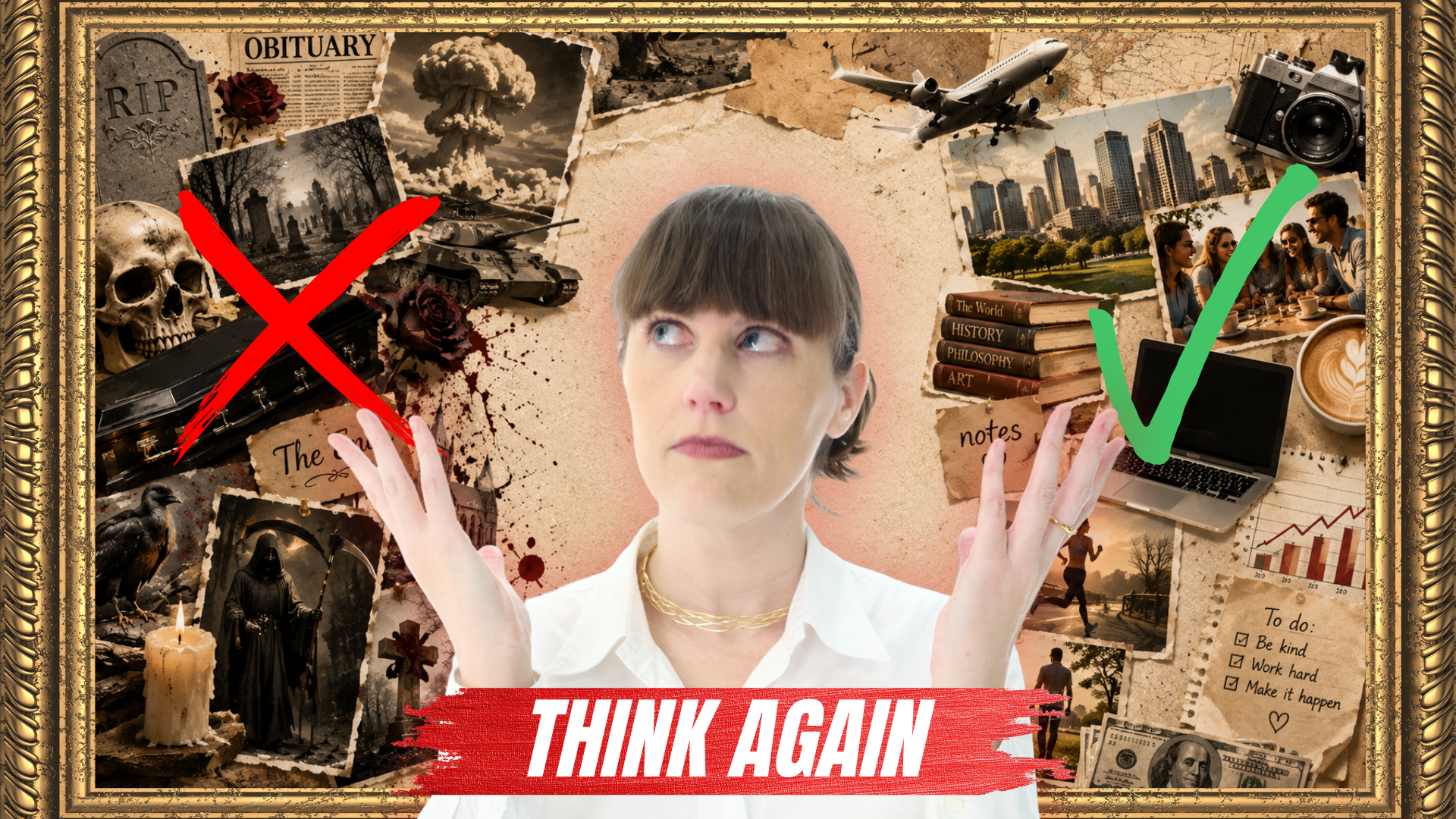
There is a popular assumption that death education is a niche package. Something you pull off the shelf only when someone is actively dying, when you’ve just lost a loved one, or when you’re filling out the paperwork that confirms you do, in fact, have an estate. A will. A power of attorney. Maybe a few tidy thoughts on whether you’d prefer burial or cremation.
Very practical. Very structured. Very much not the point.
The clinical data tells a completely different story. As it turns out, your relationship with mortality is quietly running the show for almost every single area of your life, whether you choose to acknowledge it or not. The only question is whether you are managing it consciously, or whether it is managing you from the shadows.
When I tell people I work in death literacy, everyone assumes I only talk about wills, funerals, and grief. But those elements are a tiny fraction of what death awareness actually changes.
This deep dive stems from a distinct professional frustration. The modern death-positive movement has become hyper-focused on body disposal methods, green burial aesthetics, and the immediate mechanics of end-of-life care. While those initiatives are deeply necessary, they create an absurd disconnect: we expect individuals to seamlessly navigate end-of-life crises when they haven’t spent a single day of their active lives developing a relationship with mortality.
Let’s take a completely unnecessary tour through what death literacy actually dictates across an entire lifespan.
1. Death Anxiety Is a Mental Health Issue Wearing a Trench Coat
Before unpacking demographic anomalies, we must establish a core psychological truth. A definitive 2024 meta-analysis led by Rachel Menzies and colleagues at the University of Sydney (published in Clinical Psychology Review) analyzed data from 104 papers representing over 24,000 participants. They confirmed a profound, undeniable correlation between unmitigated death anxiety and overall mental health symptoms.
The researchers described death anxiety as transdiagnostic. This means it is an existential undercurrent that feeds an array of clinical issues rather than neatly belonging to any single condition. Long-term, unprocessed death anxiety is a core driving engine behind:
- Health Anxiety & Panic Disorder: A hyper-vigilance to bodily changes misread as immediate fatal threats.
- Obsessive-Compulsive Disorder (OCD): Specifically where cleaning, contamination fears, and counting rituals function as an unconscious defense against decay and physical harm.
- General Anxiety & Depression: An underlying dread regarding the limitations of time and lack of control.
Approximately one in five Australians experiences a mental health condition in any given year. A massive, unaddressed portion of that psychological burden is simply death anxiety with nowhere to go—ignored by a clinical landscape that rarely trains practitioners to look for it.
2. Teenagers Aren’t Invincible—They Think They’re Already Dead
The conventional cultural script claims that teenagers engage in reckless behavior because they feel completely invincible. They supposedly believe they will live forever. The empirical evidence shows that the exact opposite is true.
Pioneering research by Baruch Fischhoff and colleagues revealed that 15- and 16-year-olds wildly overestimated their immediate probability of dying within the year at approximately 19%, and their chance of dying before exiting their teens at 20%. These figures are mathematically catastrophic compared to actual, nominal adolescent mortality rates.
This psychological state is known as fatalism—the implicit belief that a short life is inevitable. Longitudinal data from the massive Add Health cohort (tracking over 20,000 adolescents) established that teenagers who perceived a 50-50 or lower chance of living to age 35 were drastically more likely in young adulthood to:
- Suffer from chronic suicidal ideation and attempt suicide.
- Engage in heavy, self-destructive substance abuse.
- Completely discard the motivation to delay gratification for future benefits.
If a young person unconsciously believes they won’t be around to inherit a future, the evolutionary case for protecting that future completely collapses. Death literacy for adolescents is not a soft exercise in processing grief; it is a vital identity intervention. By establishing an honest, non-panicked relationship with reality, programs like the evaluated “Beyond the Wall” curriculum have proven to rapidly lower high-risk behavior by giving teens a future-oriented framework worth investing in.
3. The 25 to 55 Bracket: The Most Anxious Demographics Alive
Counterintuitively, older populations consistently demonstrate the lowest baseline levels of death anxiety. The peak of existential terror belongs almost exclusively to middle adulthood—the 25 to 55 demographic. This is the over-extended, stressed-out engine room of society carrying the mortgages, the career ladders, the children, and the aging parents.
The Sandwich Generation & Unnamed Grief
Data from the National Institutes of Health indicates that nearly two-thirds of sandwich-generation caregivers experience intense, sustained emotional strain. What is rarely named by professionals is that this strain is predominantly anticipatory grief. Watching a parent slowly decline through dementia or physical failure is a prolonged, ambiguous loss that occurs over years.
Because our culture lacks existential language, this grief is rarely processed. Instead, it expresses itself as erratic irritability, burnout, and systemic family friction. Death literacy provides a definitive diagnostic name for this state. It shifts a caregiver from a state of chaotic emotional drowning to structured, conscious treading water.
The Midlife Crisis Reworked
In middle adulthood, an individual’s relationship with time undergoes a profound structural shift. Instead of unconsciously counting years *since birth*, the mind begins calculating time *until death*.
When this reality hits a psychological system completely devoid of death literacy, the results are predictably catastrophic. The classic, stereotypical midlife crisis—the impulsive affair, the erratic financial purchases, the sudden identity pivots—is nothing more than a desperate, unmediated response to sudden mortality salience.
Alternatively, the empirical data shows that conscious, deliberate contemplation of one’s finitude radically increases intrinsic goal orientation, slashes superficial selfishness, and accelerates authentic identity integration. It turns an identity breakdown into a genuine psychological evolution.
4. The Immortality Projects: Career, Consumerism, and Media
When death anxiety remains unconscious, it forces individuals to build what Ernest Becker defined as “immortality projects”—subconscious systems designed to bypass the reality of physical death by achieving symbolic significance.
- The Parent Trap: Parents lacking death literacy routinely turn their children into immortality vehicles. They over-invest in their children’s precise achievements and choices because they cannot sit with their own finitude. A death-literate parent can separate their own existential security from their child’s life, allowing them to parent the actual human being in front of them.
- Exploitative Materialism: Published consumer research by Arndt & Solomon confirms that sudden, subtle reminders of death dramatically spike materialistic aspirations and impulsive buying intentions. When people are existentially insecure, they cling desperately to physical possessions and wealth as a symbolic psychological buffer.
- The Political Pipeline: Extensive meta-analyses spanning thousands of global participants prove that raw mortality salience instinctively drives humans toward aggressive in-group favoritism, intense hostility toward out-groups, and a sudden craving for charismatic, authoritarian leaders who promise absolute protection.
The endless cycle of fear-mongering media and tribalist politics works precisely because your unaddressed death anxiety is an incredibly lucrative fishing pond. A death-literate individual is fundamentally un-hookable. They can sit comfortably with existential discomfort without needing to purchase a product or find a political scapegoat to feel safe.
5. Early Retirement: The Collapse of the Primary Shield
Here is a clinical reality that is completely excluded from financial retirement planning conversations: a staggering 41% of retirees experience moderate to severe identity disruption within the very first year of leaving the workforce.
For forty years, a career functions as an individual’s primary immortality project—the ultimate boilerplate answer to whether their existence matters. The second that framework is removed, the existential questions do not retire; they simply stop being answered.
A person entering retirement without strong death literacy is instantly exposed to a concentrated wave of mortality salience as peers begin to fall ill. Without a pre-built internal framework of meaning unrelated to institutional productivity, post-retirement depression frequently sets in as an anticipation of ultimate non-existence.
Purpose is not a soft psychological luxury; it is highly physiological. Definitive longitudinal data directly links a firm, conscious sense of existential purpose in early retirement with significantly lower mortality risks, vastly improved sleep architecture, and sharply reduced clinical depression rates over the subsequent decades. Purpose dictates whether your biology functions.
The Choice Is Singular
We have somehow collectively agreed to a bizarre societal framework where one of the most powerful determinants of mental health, parenting dynamics, consumer vulnerability, and political radicalization is treated as a niche specialty to be ignored until an absolute crisis occurs.
Unconscious death anxiety leaves you entirely exposed to systemic manipulation, chronic treading water, and reactive life choices. Conscious, processed death literacy creates an unshakeable groundedness, deep generational legacy motivation, and true personal autonomy.
It is not a niche conversation for the end of life. It is the foundational landscape of living well.
Go talk death.
Advanced Care Workbook
A meticulous guide for cleanly and legally documenting personal and medical values before transitions occur.
Access Digital Workbook →Death Literacy Checklist
An actionable diagnostic tool designed for individuals and workplace teams to gauge existential readiness.
Download Free Audit →
Leave a Reply