
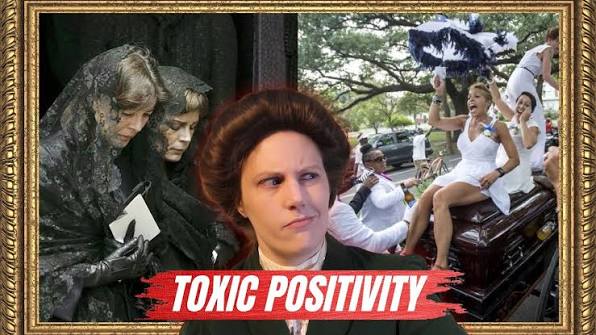
In today’s world, the West loves to complain about the funeral industry taking their money, and they love to act smart with their “funerals are pointless anyway” remarks. Both points fall apart with 30 seconds of critical thinking outside the death avoidance bubble our society has created.
<For those of you who have just found us, welcome to Taboo Education. We post videos every Friday looking at death from every possible angle. So, if that sounds like your cup of tea, consider subscribing to the channel.
Instead, the West has decided that since funerals are pointless, we’ll create the “celebration of life” instead. These upbeat, no-one-is-allowed-to-be-sad, everything-bright-colors funeral replacements are the reasons why you feel funerals are pointless. So, let’s take a look at what funerals were actually supposed to do, why you refuse to do it, and why celebrations of life are soulless, death-avoidant black holes that are actually horrible for your wellbeing.
What is a Funeral Actually For?
Before asking what’s gone wrong with funerals, it’s worth asking what they were always supposed to do. The answer is not, despite persistent cynicism, primarily to generate revenue for an industry. We actually have a video about that. That critique, while not entirely without merit, is simply an easy scapegoat.
Funerals predate the funeral industry by millennia. Every human culture in recorded history has had them, in forms ranging from the elaborate to the minimal, but present nonetheless. That kind of universality suggests a funeral is meeting a need that is genuinely human.

A funeral does several things at once. It marks the reality of the death, making it concrete and undeniable for the people who love the deceased. It gathers the community, signaling that a loss is a collective event and not merely a private one. It gives the bereaved a structured role to occupy at the moment when they are feeling disorientated, so that the body knows what to do even when the mind cannot function.
And importantly, it opens a sanctioned space for grief. A place and a time where weeping, wailing, and visible sorrow are not just permitted, but expected.
The ritual does not create the grief. The grief was already there. The ritual simply gives it somewhere to go. This last function is perhaps the most important and the most underappreciated. Human beings need permission to feel their feelings in public. The funeral is one of the few remaining social occasions where grief is the correct response. Where breaking down is not an overreaction, but an entirely proportionate one.
When the ritual is working as it should, the mourner is held by the community and by the structure of the occasion itself. They are not alone in their loss. The community has shown up, and the form of the gathering tells everyone present what their role is: to bear witness, to stay close, and to absorb some of the weight.
The “Invisible Death” Trap
The celebration of life did not emerge out of nowhere. It is the latest expression of a cultural tendency that has been building in the West for over a century.
The historian Philippe Ariès traced this arc in detail, describing how Western attitudes towards death shifted from what he calls the “tame death” of the medieval period—accepted, public, and communal—towards what he termed the “invisible death” of the modern day, in which dying is hidden in hospitals, grief is privatized, and death itself is treated as something between an embarrassment and a failure.

Ernest Becker, writing The Denial of Death in 1973, went further, arguing that much of human culture is an elaborate and largely unconscious defense against the terror of our own mortality. We build civilizations, leave legacies, follow religions, and construct meaning precisely because we cannot bear to sit with the knowledge that we will die.
The problem with defenses, as any psychologist will note, is that they work in the short term and accumulate cost over time. A society that has become very good at not thinking about death does not suffer any less grief. It simply suffers it less well.
The celebration of life is a near-perfect expression of this tendency. The language alone is doing a vast amount of work. “Celebration of life” orientates attention towards the past, towards the fact that someone once lived, away from the present, the fact that they have died.
Death gets mentioned as little as possible. The word “funeral” is increasingly avoided, as if it carries some sort of contagion. The result is a ceremony that gestures at loss while systematically refusing to look directly at it.
The Problem with Positivity and “No Crying”
There is a specific instruction that has become common in recent decades, issued in advance by the aging or dying and dutifully honored by those left behind. And it goes something like: “No sad faces at my funeral. Bright colors only. I want people to celebrate, not mourn.”
The instinct behind this is almost always kind. People do not want to cause pain. They do not want to be remembered in an atmosphere of misery. They want to be associated with joy. But the instruction, however lovingly intended, contains several problems worth examining.
The first is that it tries to author an experience for people who are in the middle of their own horrible experience. The mourners at a funeral are not there to perform the deceased’s preferred self-image. They are there because they’re in pain, because someone they loved is gone, and because they need a space to acknowledge that.
When the deceased has issued instructions about the emotional tone of the occasion, the mourners are placed in an impossible position. If they cry, they feel they have violated the wishes of the person they are grieving. Even though that person is rotting in a box right in front of them and ain’t coming back to complain, they are managing the guilt on top of the grief, which is a remarkable burden to place on someone in the acute phase of loss.

The second problem is that grief is not a choice. When someone asks you not to cry at their funeral, they are asking you to suppress the involuntary physiological and emotional response to one of the worst experiences of your life. The instruction mistakes grief for a performance when it is, in fact, a reflex—the body’s honest response to loss.
The third problem is that the “no crying” directive is almost certainly encoding something the person issuing it had not quite fully examined. There is guilt in that. The fear of having burdened the mourners with their grief. There is an identity in it. The desire to be remembered as someone joyful and light rather than heavy. And there is, underneath both of those, a confrontation with mortality that the person could not quite complete.
The thought of a room full of weeping people and a coffin, a procession, the full weight of the ritual is confronting precisely because it makes death feel real and final and significant. A party is easier to imagine. So the instruction is partly issued to comfort the dying person themselves, a way of making their own death more bearable to contemplate.
Celebration vs. True Mourning
It is important to be clear that joy and grief are not opposites, and that a genuinely mourning funeral can contain both.
The Irish wake, the New Orleans jazz funeral, the raucous storytelling that follows a burial in many cultures—these are not failures of mourning. They are expressions of it. Laughter at a wake is real laughter, but it grows out of grief. Everyone in the room knows why they are there. The sorrow is the water they are swimming in. And the joy is what occasionally breaks through it.
That is a very different thing from a ceremony designed to skip the swimming altogether and go straight to the fun.
The celebration of life often attempts exactly that skip. It reaches for the uplift without earning it through the genuine reckoning of the loss. The result is an occasion that can feel for many mourners vaguely fraudulent.

They are standing in a room full of people in bright clothing, holding a glass of something sparkling, listening to the deceased’s favorite playlist and feeling their grief with nowhere to put it. The ritual has not made space for what they are actually experiencing. It has, with the best of intentions, closed that space off.
This matters because grief with no container doesn’t disappear. It relocates. Research on bereavement consistently finds that suppressed or unexpressed grief tends to resurface later, often in ways that are harder to recognize and address. The mourning ritual that looks grim from the outside is doing real psychological work. It is giving grief somewhere to go in the presence of a community, which is the condition under which human beings have always processed loss the most effectively.
The Collapse of Communal Grief
Underneath all of this lies something that rarely gets named directly, but is felt by almost everyone that has attended a modern funeral: We no longer know what to do with a grieving person.
For most of human history, communities carried inherent wisdom about how to sit with loss. You stayed. You brought food. You did not try to fix it, or reframe it, or find the silver lining. You simply remained present in the grief with the person who was suffering with it.
Mourning periods had structures, often lengthy ones, that told the community how long to stay close and signaled to the bereaved that their loss was socially recognized and supported. The Jewish shiva, the wearing of black for a year, the formal period of mourning observed across many cultures. These are not arbitrary customs. They are technologies for managing collective grief, developed and refined over generations.
Most of that inherited structure has been dismantled by the secular West, and nothing has replaced it. What remains is a profound social awkwardness around grief. People genuinely do not know what to do or say.
The instinct is to comfort, to fix, to move the grieving person towards feeling better as quickly as possible because their pain is uncomfortable to witness, and there is no longer a shared script for simply being present in it.
“He’s in a better place.” “At least she didn’t suffer.” “You’ll get through this.”
All of these are ways to try and close the wound rather than acknowledge it, driven not by cruelty, but by helplessness.
The result is that a funeral where people are visibly and inconsolably grieving has become genuinely frightening to many mourners. Not because they don’t care, but because they have no idea what to do with it. The celebration of life format removes that risk. Everyone stays at a manageable emotional temperature. No one has to do the hard thing, which is to stay present with another person’s pain without trying to resolve it.
The Unspoken Rules of Modern Funerals
There is an unspoken set of rules operating in modern funerals. You do not cry too hard, and if you do cry, you recover quickly. Accept comfort graciously, and then signal that you’re all right. Do not make it too real for everyone else. Perform grief in a way that does not require anything of the people around you.

That is, when stated plainly, a remarkably cruel set of expectations to place on someone in the acute phase of loss. And yet, it operates almost invisibly, enforced not by anyone’s explicit intention, but by the collective discomfort of a community that has lost the ritual scaffolding and doesn’t know what to stand in its absence.
The therapeutic culture that surrounds grief has paradoxically made this worse in some respects. We live in an era that talks about mental health more than any of the previous generations and yet have less practical capacity to sit with another person’s pain than most cultures that preceded us.
We have professionalized grief. It belongs to therapists, counselors, and support groups. The ordinary social skill of simply being with someone who is suffering has quietly atrophied because we have decided it requires expertise. It requires someone else to do the work for us.
The community shows up for the funeral and then disperses, often with visible relief, leaving the bereaved to manage the real weight of it alone.
The Widow at Home Alone
This is the sharpest version of the argument and it’s worth stating without softening: A celebration of life is not a gift to the bereaved. It’s a gift to everyone else in the room.
Western culture has spent several decades celebrating individualism, teaching that community is optional, that your feelings are your business and other people’s feelings are their business. That is not merely a political or economic philosophy. It has seeped into the texture of everyday life, into what we feel we can reasonably ask of another person and what we feel obligated to give.
The answer, increasingly, is not very much.
We have quietly renegotiated the social contract around suffering downward to the point where showing up once, briefly, in brightly colored clothing, and then going home is considered adequate. It’s not adequate. It has never been adequate. But we have collectively agreed to pretend otherwise because the alternative asks something of us that we are no longer culturally equipped or willing to give. And then people complain that they’re lonely.
Consider what actually happens. Someone has just lost their partner. The person they built their entire life alongside. The person they slept next to, argued with, made plans to grow old together with. The absence is not just emotional. It is physical, spatial, domestic.
The house sounds different. The bed is wrong. There’s no one to tell things to.

The grief is not an event. It is a new permanent texture of every single day. And what does that person get? A party that they helped to plan and pay for, in colors they didn’t choose, for the comfort of the people who will drive home afterwards and not think about them again till Christmas.
Then they go home alone to a house that sounds different to deal with their pain alone.
That is a collective failure. Not anyone’s individual failure, but a failure of what we have decided a community means and what we are willing to do for one another.
The Ultimate Cost
The funeral industry does profit from grief, and that critique has merit, but it is also a distraction from something more uncomfortable. The celebration of life is not cheaper than a funeral in any meaningful sense. It still costs money, often a great deal of it.
What it purchases, additionally, is a curated experience of not-quite-grieving together. You pay for convenience. You’re paying, in other words, for an occasion carefully arranged to keep everyone emotionally safe.
The money is real. The function is not.
A genuine mourning ritual does not require significant expenditure. We’ve done a few videos on this on how to have an affordable funeral. No, it requires presence. It requires people staying. It requires the community absorbing some of the unbearable weight of loss by simply refusing to leave the bereaved person alone with it.
That costs nothing except time and the willingness to be uncomfortable, which is precisely why so many people no longer do it. We have decided without quite saying it that grief is the griever’s problem. Your loss belongs to you. It is your emotional event to manage, ideally with professional support, ideally without making too many demands of the people around you.
The community will come to the party, raise a glass, say “he would have wanted this,” and consider their obligation discharged.
But grief is not a private event. It never has been. The idea that it is historically bizarre, compulsory thin, and psychologically damaging. Loss happens to a person within a web of relationships. And whatever healing is possible happens within that same web.
It requires other people to stay close, to keep showing up, and to sit with difficulty without flinching. It requires a community to say with its actual physical presence over actual time that your loss matters to us and we’re not going anywhere.
A real mourning ritual is not comfortable. It asks you to look at death, to sit with someone in acute pain, and to stay where every social instinct tells you that you have done your bit and you can leave. It asks you to say nothing useful because there is nothing useful to say, and to be there anyway. It asks you to put your own discomfort aside for the need of someone who is suffering in a way that you probably cannot fully imagine.
That is genuinely hard.
And we have built an entire alternative ceremony whose primary function is to let us off the hook, dress it up in language of honoring the deceased and celebrating a life. But the deceased does not need honoring. The deceased is gone.
The person who needs something is the one who is still here, sitting in that house that sounds different, trying to understand how to live in a world that no longer contains the person they love the most.

A funeral that flinches from the thing that it exists to address is not doing its job. The celebration of life is a kind gesture dressed up as a ritual. But kindness and ritual are not the same thing.
A ritual works because it is not optional, not personalized, not arranged to accommodate everyone’s comfort. It works because it is the same for everyone, because its forms are inherited rather than invented. And because it asks something of people who participate in it: it asks them to show up, to stay, to bear witness to loss together.
When it is replaced by an occasion designed to keep everyone comfortable, to celebrate rather than mourn, to look forward rather than directly at the fact of death, something is lost and is genuinely hard to recover.
The bereaved leaves without having been fully met in their grief. The community disperses without having done the work of collective mourning. And the death, the real event at the center of all of it, has been politely but firmly kept at arm’s length. This is why people think funerals are pointless.
Grief in its most general form is not a mental health diagnosis. It is not a weakness. It is not something to be managed or minimalized or redirected towards celebration. It is love with nowhere to go. And it deserves a ritual built specifically to receive it.
The funeral at its best and oldest was exactly that. What we have built in its place is something gentler, tidier, and considerably less useful.
And with that, go talk death.
Equip yourself and your family with organized frameworks before a crisis limits your choices.
Advance Care Workbook
Step-by-step professional guidance for cleanly and legally documenting your final medical and personal wishes.
Get the Workbook →Death Literacy Checklist
A simple, actionable self-assessment tool designed for individuals navigating complex organizational systems.
Download Free Tool →
Leave a Reply