
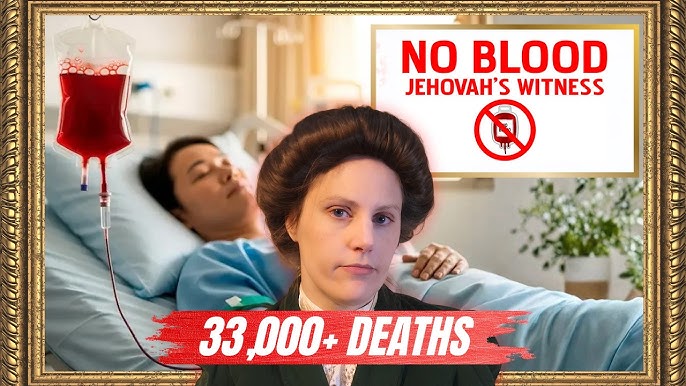
We are all aware of the rule in the Jehovah’s Witness faith about no blood transfusions. But do you know why? A few months ago, the religion made some big, unprecedented changes to this rule. So, while I’m updating you, let’s go through why they had this rule in the first place, how it has been changed recently, and why the medical community is opening their eyes now to the positives of their bloodless ways.
Origins of the Movement
Jehovah’s Witnesses originated near Pittsburgh, Pennsylvania, in the 1870s when Charles T. Russell formed a movement based on a literal millennialist interpretation of the Bible. From those early days, the movement cultivated a strong sense of separateness from mainstream society, distinguished by the belief that the world around it was morally compromised and spiritually corrupt.

The group relocated to Brooklyn, New York, in 1909 as it began to expand its organizational operations and publishing reach. Russell died in 1916 and was succeeded by Joseph F. Rutherford, a lawyer from Missouri who led the community through many of its early legal conflicts with the United States government until his death in 1942.
Rutherford’s tenure was formative in a deeper sense. He oversaw a period of intense persecution of witnesses who refused military service and other civic obligations, which pushed the organization to draw sharper boundaries between itself and secular society. It was precisely this atmosphere of persecution and internal consolidation that created the doctrinal conditions for the later emergence of the blood transfusion prohibition.
Witnesses had already developed a posture of conscientious objection to medical practices they considered pagan and contrary to scripture, including vaccinations. The blood doctrine that followed was not an isolated development, but an extension of this established pattern of resistance.
The 1945 Declaration: Birth of the Blood Doctrine
The first official statement on blood transfusions appeared in the Jehovah’s Witness official magazine, The Watchtower, on the 1st of July, 1945. It declared that blood transfusions were pagan and god-dishonoring. This was a pivotal and consequential moment.
The timing was not coincidental. The Second World War had dramatically expanded the use of blood transfusions in military medicine, making the procedure far more visible and widely discussed than it had ever been before. The Watchtower Society’s ruling can be understood partly as a response to that cultural moment, drawing a clear line between faithful witnesses and a world that had embraced what the organization considered a violation of divine law.
Over the following decades, the doctrine had to evolve continuously to keep pace with the advances of medicine. The original blanket prohibition of whole blood was progressively refined as new technologies emerged, including blood fractionation, autologous transfusions (using one’s own stored blood), and synthetic blood substitutes. Each innovation forced the organization to make theological rulings about where exactly the line was to be drawn between acceptable and prohibited treatments.
The Biblical Basis
The doctrine rests on several key scriptural passages. Jehovah’s Witnesses draw primarily from Genesis 9:4, Leviticus 17:10, and Acts 15:28-29, interpreting these texts to mean that blood represents life itself and is sacred to God. They believe that once the blood has been removed from the body, the only divinely authorized use for it is in the atonement of sins.
- The dietary logic runs from Genesis: “Only flesh with its life—its blood—you must not eat.”
- Through Leviticus: “I will certainly set my face against the one who is eating the blood.”
- With a reliance on Acts 15:28-29 being particularly significant, because it extends the prohibition beyond the Old Testament dietary laws directly into the Christian era.
A Watchtower article on the 1st of July 1951 made the critical leap, arguing that food and blood transfusions amount to the same thing insofar as both introduce substances into the body. Critics have long contested this reasoning, noting that digestion and intravenous transfusion are physiologically distinct processes, but the Watchtower Society held firm. Blood entering the body by any route was equally forbidden.
What is Prohibited and What is Allowed?
Jehovah’s Witnesses organize blood into four primary components: red cells, white cells, platelets, and plasma. Members are expressly forbidden from receiving transfusions of whole blood, any of these four components, or anything whose primary function corresponds to any of those primary components.
However, numerous exceptions have developed over the decades, producing a complex and at times contradictory landscape as to what is and is not permitted. Procedures in which blood leaves the body but remains in continuously flowing circuits, such as hemodialysis or cardiopulmonary bypass, are generally considered acceptable on the grounds that the blood outside the body can still be regarded as part of the believer’s body so long as the circuit is uninterrupted.
These distinctions highlight a significant internal tension. The Watchtower’s position has always been that God’s standard requires that blood removed from the body must not be stored. And yet, the organization allows witnesses to use blood fractions derived from donated blood that has, by necessity, been stored. Witnesses are permitted to benefit from blood fractions, but are forbidden from donating blood themselves.
Critics have argued this creates a profound moral inconsistency in which the organization benefits from a public blood supply system that it will not contribute to.
Social Consequences and Legal Battlegrounds
The social stakes of the blood doctrine have always been severe. Members who voluntarily accept a transfusion and are not considered repentant are regarded as having effectively disassociated themselves from the organization by abandoning its doctrines and are subsequently shunned by fellow members. For many witnesses, the prospect of shunning by family and community is a powerful deterrent to accepting treatment, even in life-threatening circumstances.

Additionally, a blood transfusion is considered a severe spiritual violation that can jeopardize their eternal salvation. The experience of a forced transfusion carries its own particular weight for believers. For a witness who accepts the doctrine, a court-ordered or medically administered transfusion is experienced not primarily as a physical violation, but as a spiritual one—the profound sense of having been robbed of the opportunity to demonstrate faithfulness, and having a moment of physical vulnerability exploited to impose a treatment at odds with their deeply held beliefs.
The constitutional arguments advanced by witnesses rest on two main pillars: that forced transfusion constitutes an invasion to the right of privacy, and that it violates the individual’s freedom of religious practice.
Cases involving children have been especially contentious, with courts in Australia, the UK, and the US frequently overriding a parent’s refusal when a minor’s life is at risk. Australian courts, in particular, have been highly consistent in authorizing transfusions for minors, even against the express wishes of both parents and, in some cases, the minor themselves.
The Rise of Bloodless Medicine
The Watchtower Society has long invested in supporting witnesses to access treatment that does not involve blood transfusions. It established hospital information services to provide education and facilitate bloodless surgery, and maintains hospital liaison committees worldwide to assist members.
The broader medical community’s response to bloodless medicine has shifted considerably over the decades. What was once regarded as an extreme or even reckless approach to surgical care has increasingly been recognized as offering genuine benefits for all patients, not just those with religious objections.
- A 2004 article in a medical education journal predicted that many of the techniques developed to use on Jehovah’s Witness patients would eventually become standard practice.
- An article in the journal Heart, Lung, and Circulation in 2010 went further, arguing that bloodless surgery should be regarded not as a special accommodation for a minority religion, but as an integral part of everyday surgical practice.
- Today, around 200 hospitals offer dedicated bloodless medicine and surgery programs.
- Approximately 108,000 physicians have indicated a willingness to provide bloodless treatment when requested.
Survival data has added further complexity to the debate. Studies have found that witnesses who underwent surgery without transfusion had a higher survival rate long-term compared to non-witnesses who received blood transfusions. While these figures do not establish that blood transfusions are inherently harmful, they do suggest that careful bloodless surgical practices can produce outcomes at least comparable to those achieved with transfusion, particularly in elective or planned procedures.
Ongoing Debate and the March 2026 Policy Change
The ethical and legal issues raised by the blood doctrine have never been fully resolved, and debate continues both outside and within the witness community. A notable organization, the Associated Jehovah’s Witnesses for Reform on Blood, has long argued from within the organization that the traditional blood doctrine rests on flawed biblical interpretation and has caused unnecessary deaths.
One medical adviser from this organization has reported that since 1961, an estimated 33,246 Jehovah’s Witnesses died as a result of the blood prohibition—working out on average to roughly 594 deaths per year. Because most such deaths are recorded under their immediate medical cause (hemorrhage, severe anemia, etc.) rather than the underlying factor of transfusion refusal, the true toll is impossible to determine with absolute precision and is almost certainly underrepresented in official statistics.

In a significant and widely reported development, the governing body of Jehovah’s Witnesses announced in March 2026 what it described as a clarification of the teachings on blood. It now allows members to decide for themselves whether to have their own blood drawn and stored in advance for use in procedures, such as scheduled surgeries involving a significant risk of blood loss.
The announcement was made via a video statement posted on the organization’s official website. Governing body member Garrett Losh stated, “Each Christian must decide for himself how his blood will be used in all medical and surgical care. This includes whether to allow his own blood to be removed, stored, and then given back to them.”
The organization is retaining its wider ban against receiving transfusions of another person’s blood, which remains one of its most distinctive and controversial teachings. The change was particularly striking given the organization’s long-standing position. Older advanced medical directive forms explicitly told members to refuse blood transfusions under any circumstances and to absolutely refuse to pre-donate and store blood for later infusion.
Critics have noted the apparent inconsistency: blood is still removed, stored, and reintroduced into the bloodstream, which was precisely what the previous doctrine strictly prohibited. Some former members welcome the changes as meaningful but ultimately insufficient.
Mitch Melon, a former witness from Washington State, said, “I don’t think it goes far enough, but it is a significant change.” He noted that the policy still does not allow witnesses to accept donated blood in true emergencies. This means that members involved in violent accidents, experiencing massive trauma, or requiring multiple transfusions to treat conditions like certain childhood cancers remain entirely bound by the original ban.
A further practical concern raised by critics is that the new allowance presupposes access to cutting-edge facilities capable of safely drawing and storing a patient’s own blood in advance for surgery—a luxury which is totally unavailable to many witnesses living in lower-income countries.
The organization currently reports a United States membership of 1.3 million and a worldwide membership of 9.2 million across more than 200 countries and territories. The March 2026 announcement represents the most significant shift in the blood doctrine since its gradual liberalization policies around blood fractions in the 1990s and early 2000s. It is highly likely to prompt renewed debate, both legal and theological, about where the organization’s remaining bans should ultimately stand.
Whether you agree with them or not, it is fascinating to watch how various religions attempt to work within the confines of the modern world.
Equip yourself and your family with organized frameworks before a crisis limits your choices.
Advance Care Workbook
Step-by-step professional guidance for cleanly and legally documenting your final medical and personal wishes.
Get the Workbook →Death Literacy Checklist
A simple, actionable self-assessment tool designed for individuals navigating complex organizational systems.
Download Free Tool →
Leave a Reply