
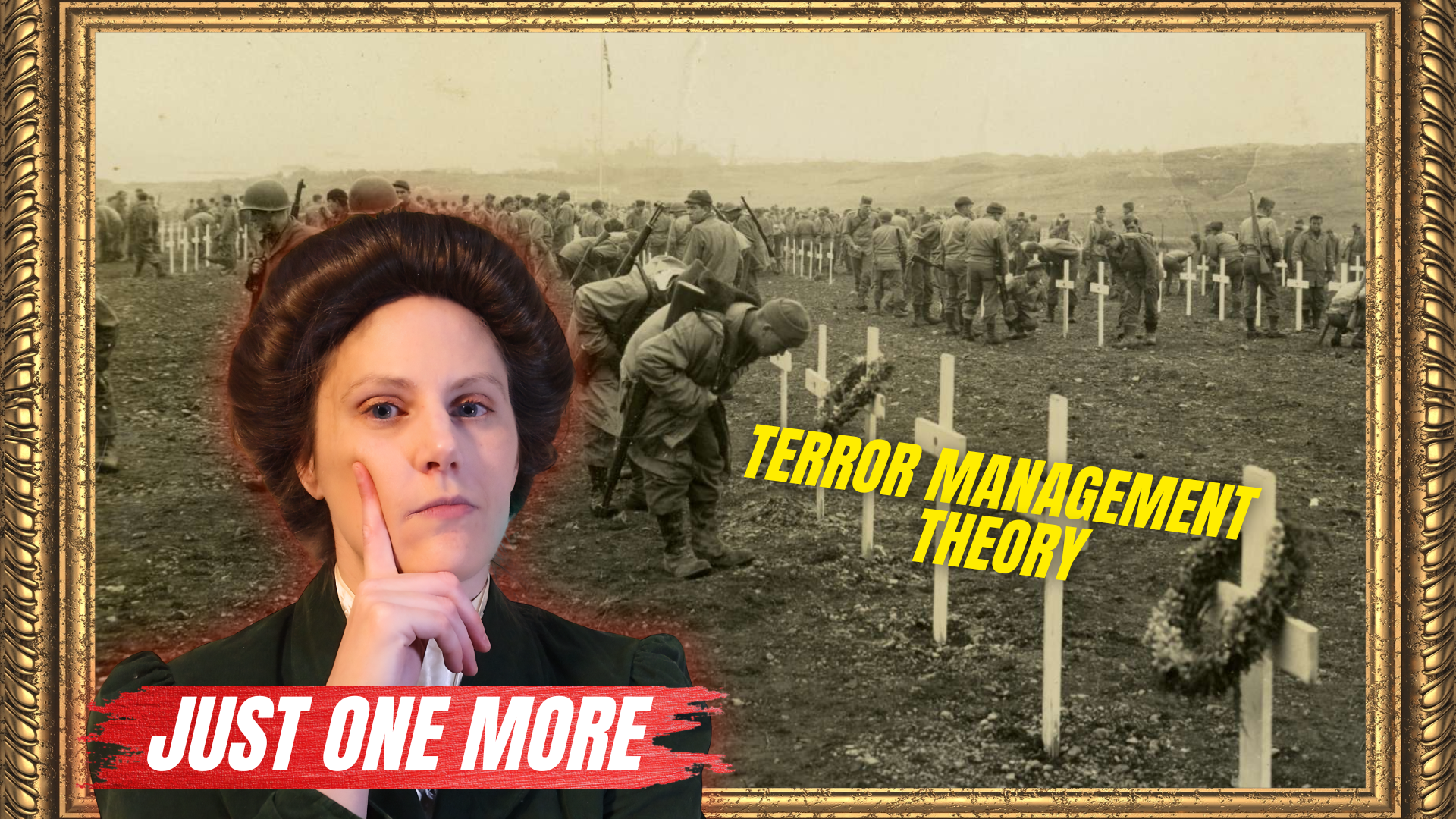
It occurred to us the other day: Taboo Education is a death literacy channel with well over 200 long-form videos under our belt, and yet we haven’t officially dived into one of the most foundational psychological frameworks surrounding death anxiety. Today, we are correcting that. Welcome to Terror Management Theory (TMT)—the psychological framework arguing that death anxiety is the hidden engine driving almost all of human behavior, whether we are brave enough to admit it or not.
You are going to die. You already knew that. But here is the part your brain aggressively resists: that knowledge is so deeply threatening that your entire personality, your political views, your religion, your tribe, and your need to feel special are largely elaborate defense mechanisms constructed to keep you from confronting your own mortality.
Developed in the 1980s by researchers Jeff Greenberg, Sheldon Solomon, and Tom Pyszczynski—building on Ernest Becker’s Pulitzer Prize-winning book The Denial of Death—Terror Management Theory argues that human civilization is, at its core, one long collective attempt to pretend we aren’t animals destined to rot in the ground.
What Is “Mortality Salience” and Why Does It Matter?
Mortality salience is simply the psychological term for how consciously aware you are of your own death at any given moment. When mortality salience is high—when death feels immediate or real—something fascinating happens in the human brain. You don’t automatically become wiser, kinder, or more present. Instead, you get defensive.
Researchers have proven this in hundreds of experiments using a method that is almost embarrassingly simple: they ask participants to write a short paragraph about what it feels like to think about their own death, and then observe their behavior immediately afterward.
The results are consistently disturbing:
- People become significantly harsher in their judgments of others.
- They exhibit greater hostility toward anyone with differing worldviews.
- They cling tighter to their group, nation, or cultural identity.
- They show a stronger impulse to punish social rule-breakers and reward those who validate their own beliefs.
In one landmark study, judges were asked to set hypothetical bail for a minor offense. Half of the judges were asked to complete a brief death-writing exercise first. The control group set average bail at $50. The judges reminded of their mortality set bail at $455—nine times harsher—for the exact same case, purely because their death anxiety had been quietly triggered.

The Two Shields We Use to Keep Existential Panic at Bay
According to TMT, human beings manage existential dread using two primary psychological mechanisms:
1. Symbolic Immortality (A Meaningful Worldview)
Every culture in history has built belief systems that grant life meaning beyond an individual’s lifespan. Religion is the classic example, offering literal immortality through an afterlife. But secular worldviews do the exact same job: believing your nation matters, that your children carry your legacy, or that your life’s work will outlast you. Becker called this symbolic immortality. You cannot live forever, but your legacy, group, or ideas can—and that takes the sharp edge off existential panic.
2. Self-Esteem (Feeling Worthy in a Meaningful World)
In TMT, self-esteem isn’t just “feeling good about yourself.” It is the felt sense that you are a valuable contributor to a meaningful universe. When you feel like you matter, death feels slightly less terrifying. When you feel insignificant, mortality becomes unbearable because there is no symbolic immortality to rely on. This explains why people who feel powerless often compensate so aggressively through road rage, rigid nationalism, or a desperate need to always be right.
Clashing Immortality Projects: Why Good People Do Terrible Things
This is where Becker’s theory turns truly dark. When two groups hold fundamentally different worldviews, they are not merely having a disagreement—they are threatening each other’s defense systems against death anxiety. If your worldview says life means one thing, and mine says the complete opposite, one of us is relying on a lie. Your nervous system perceives that ideological difference as an existential threat.
This explains the horrifying mechanics of war and historical atrocities. When people die for an ideological cause, their group cannot psychologically afford to let those deaths feel pointless. The sacrifice must be validated by continuing the fight, creating a tragic cycle where more people die to prove that previous deaths meant something.
TMT reveals that atrocities are rarely committed by cartoonish monsters; they are carried out by ordinary human beings who have surrendered their moral agency to an “immortality project” because they desperately need their lives—and deaths—to matter.
Cults, Extremism, and the Weaponization of Unacknowledged Fear
Extremist groups and cults are, at their core, master salespeople of symbolic immortality. They target individuals whose meaning-making frameworks have collapsed, offering absolute certainty, radical belonging, and a grand cosmic narrative where individual death becomes glorious rather than terrifying.
This is precisely why death literacy is a vital societal defense mechanism:
- Nuance demands effort: Nuance acknowledges that life is complex and death is real. Extremist groups sell absolute certainty.
- Death literacy builds psychological immunity: A person comfortable sitting with mortality is vastly harder to radicalize because they do not carry unacknowledged existential terror waiting to be weaponized by loud, confident leaders.
- Resilience over reaction: True death literacy isn’t just soft comfort; it is structural protection against psychological manipulation.

Why “Just Doing a Grief Workshop” Isn’t Good Enough
For decades, standard institutional responses treat death purely as a crisis management problem: hand out a brochure when someone is actively dying or grieving, tick the box, and move on. But Terror Management Theory shows us that everyone—from young children asking honest questions to middle-aged adults quietly panicking—has an active relationship with mortality every single day.
When society refuses to give people open, honest frameworks for death early in life, they cope by repressing the anxiety, leading to rigidity, hostility, and fear. Waiting until the end of life to discuss mortality is like placing an ambulance at the bottom of a cliff. Taboo Education exists to build capacity before the cliff.
Death literacy isn’t about pretending death is comfortable—it’s about building the psychological strength to look at it directly, alongside others, long before the crisis arrives. Face the discomfort, protect your mind, and go talk death.
Advanced Care Workbook
A meticulous guide for cleanly and legally documenting personal and medical values before transitions occur.
Access Digital Workbook →Death Literacy Checklist
An actionable diagnostic tool designed for individuals and workplace teams to gauge existential readiness.
Download Free Audit →
Leave a Reply