
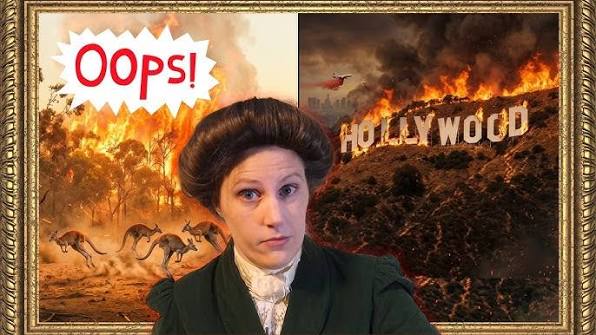
Every summer, Australia lights up like a giant barbecue that no one asked for. Millions of hectares gone, animals dead, towns wiped off the map, with the Kiwi and Canadian Fire Departments flying in to help. It’s a very reliable, if unfortunate, summer playbook over here. So, why does Australia so reliably go up in flames every year?
If you’ve just found this channel, welcome. We post death-related videos every Friday, looking at it from every angle with Aussie sarcasm. So, if that sounds like your kind of thing, consider subscribing to the channel. Now, let’s talk Aussie bushfires.
Why Australia Burns
Australia is the most fire-prone country on Earth. And that’s not hyperbole. That’s just the continent doing what it was built to do.
Three things have to line up for a catastrophic fire: fuel, heat, and wind. Australia has all three in abundance, and simultaneously. The fuel is Australian vegetation, particularly eucalyptus, which produces a flammable oil that makes it essentially nature’s firelighter. Leaf litter, peeling bark, and dry undergrowth—it all piles up between burns.
The heat comes from a climate that is structurally one of the hottest and driest. And the wind—Australia is ringed by wind systems that push hot, dry air across the interior and funnel it straight into populated coastal areas. The country has always been this way, but climate change has made all three things worse.
Australia has warmed around 1.5°C since 1910, with most of that warming since 1950. The number of days above 35°C has increased significantly. Droughts are longer. The fire season has extended into autumn. The window for safe hazard reduction burns is shrinking. But here’s the thing: the Australian landscape didn’t evolve to resist fire. It evolved with fire. And for at least 80,000 years, Indigenous Australians understood that distinction completely.
Built to Burn
Before we get on to the disasters, let’s talk about what fire actually means to this continent. Because Australia’s plants and animals don’t just survive fire—many of them depend on it.
Eucalyptus trees have epicormic buds buried under their bark—dormant growth points that activate the moment a fire passes. Within weeks of a burn, the scorched gum tree is already pushing out fresh green shoots. It doesn’t wait to recover; it’s already preparing for the next fire. Banksias go further: their seed pods are sealed so tight that only the heat of a bushfire can open them. Some have held on to seeds for years, waiting. The moment fire rips through, the cone splits, seeds rain onto the freshly cleared ash bed, and a new generation has the best possible start because all the competition burnt. Wattles do something similar.
The smoke itself contains chemicals that trigger germination in dozens of native species. The fire is essentially the signal that says, “Now is your moment.” Grass trees, those weird prehistoric-looking things with the long black trunks, only flower after fire. Some native orchids only appear in the year after a burn. The entire understory of much of Australia’s bush is a coiled spring waiting for a match.
Animals have adapted too. Sugar gliders, kookaburras, and owls survive fires sheltered inside tree hollows. Wombats and reptiles ride it out underground. Kangaroos move towards fresh post-fire growth within days. The new shoots emerge from ash beds and are exactly what they want. Birds of prey have even been observed deliberately carrying burning sticks from one fire to a new area to flush out prey. We’ve known about this behavior from Aboriginal oral tradition for generations, and scientists confirmed it formally in 2018. The ecosystem isn’t broken by fire at the right frequency. It is refreshed by it.
The problem has never been fire itself. The problem is fire at the wrong scale, the wrong season, and the wrong intensity.
Which is exactly what happens when you spend 200 years preventing the small burns that were keeping the big ones manageable.
60,000 Years of Fire Management
Aboriginal Australians didn’t just live in a fire-prone landscape; they actively shaped it using fire as a tool—a practice known as cultural burning or cool burning that was in continuous use for well over 60,000 years. The method is precise in a way that bureaucratic hazard reduction burns simply aren’t.
Cultural burns are small, low, cool fires lit at specific times, typically early in the dry season from around April to July, when overnight dew keeps the temperatures down and winds are gentle. They don’t touch the canopy; the canopy is left intact deliberately. It provides shelter and seeds for the next generation. What burns is the undergrowth, the bracken, the dead grass, and the accumulated leaf litter that would otherwise become fuel for a catastrophic fire.
The timing isn’t guesswork. Aboriginal knowledge holders read the landscape—when certain trees flowered, or when native grasses cured—to know exactly when to burn and when not to. As an Aboriginal community member put it: “The knowledge is held within the landscape. Once we learn how to read the landscape and interpret that knowledge, that’s when we apply those fire practices.”
The result was a mosaic. Patches of burnt and unburnt country in rotation, creating a patchwork of habitats that supported maximum biodiversity, controlled fuel loads, and made catastrophic fire essentially impossible at scale. Early European settlers described the landscape as looking like a park—open, grassy, and park-like—because it had been actively maintained that way for millennia.
When colonization forced Aboriginal people off their land and suppressed burning practices, that mosaic quickly fell apart. Fuel built up unchecked. The landscape Europeans protected from small fires was loading itself for enormous ones. A 2001 study found that the disruption of traditional burning directly increased the risk of extensive, uncontrolled wildfires across Australia. A 2017 study found that the removal of mature trees by European settlers triggered dense regrowth that created a far greater fire fuel hazard than existed before.
In the desert territory where traditional burning stopped in the 1950s and 1960s, subsequent uncontrolled fires destroyed vast, sweeping tracts of tens of thousands of square kilometers in just a couple of seasons. That’s the cost of ignoring 60,000 years of expertise.
The good news, if there is any, is that cultural burning is making a comeback. Dozens of Indigenous-owned fire management projects are operating across millions of hectares in northern Australia, abating around one million tons of carbon emissions per year. The land is being listened to again. Whether it’s happening fast enough is a different question. You can’t stop fire in Australia—you can only manage it, or ignore it until it manages you.
Australia’s Deadliest Hits: Black Summer & Beyond
Australia’s deadliest bushfires read like a greatest hits album that no one wanted to release.
- Black Friday (1939, Victoria): Temperatures in Melbourne hit 44.7°C. Fires tore through two million hectares, obliterated entire towns like Narbethong and Noojee, and killed 71 people. A royal commission followed.
- Ash Wednesday (1983, Victoria and South Australia): 75 dead, nearly 1,900 homes destroyed, and 104 fires burning simultaneously by a single morning. The energy released was reportedly equivalent to 1,500 Hiroshima-style bombs.
- Black Saturday (2009, Victoria): The single deadliest fire event in Australian history. 173 people killed. Over 430,000 hectares burned, more than 2,000 homes gone, and almost 80 communities left unrecognizable. Melbourne had experienced three consecutive days above 43°C beforehand—the first time that was ever recorded.
Then came the Black Summer of 2019 to 2020, the worst fire season on record. Full stop. Over 24 million hectares burnt, and 33 people were killed directly. Smoke from the fires was responsible for an additional 417 deaths. An estimated 3 billion animals were killed or displaced. We lost 70% of the koala population from those areas. The air quality in Canberra on New Year’s Day in 2020 was the worst of any city on the planet. The fires generated their own weather systems—fire tornadoes, lightning, and pyroconvective storms.
People outside of Australia struggle to grasp the scale. In 1974 to 1975, fires burnt between 100 and 117 million hectares across central Australia—roughly 15% of the entire continent. That’s an area the size of France and Spain combined. Three people died, largely because nobody lives out there. The Black Summer fires burned 24 million hectares. For context, the entire Amazon lost 10 million hectares in fires in 2019 and the world lost its mind. Australia lost more than twice that in a single season in a country with a modest population.
The reason Australia doesn’t always top the global human death toll despite burning such enormous areas is geography. Most of what burns is remote scrub and grassland. When fire hits the urban fringes—the outer suburbs of Melbourne, or the holiday towns of the New South Wales South Coast—that’s when people die.
The “Death Tree” We Sent to America
Here’s where it gets interesting for our US viewers, and where Australians can either feel smug or guilty depending on your outlook. When Los Angeles burned in January 2025, killing dozens and destroying over 12,000 structures, one question kept surfacing: What role did eucalyptus play?
The tree most responsible for Australia’s fire problem is now all over California, and the path it took to get there is pretty wild. A German-born botanist named Ferdinand von Mueller immigrated to Australia and became completely obsessed with eucalyptus. He spent decades evangelicalizing these trees, writing books, corresponding with botanists globally, and mailing seeds all over the world. It was essentially the apple seed of an ecological catastrophe.

By the 1850s, eucalyptus seeds were arriving in California during the Gold Rush. California authorities, desperate for timber after clearing most of the native trees, encouraged mass planting. By the early 1900s, thousands of acres of eucalyptus, mostly Tasmanian Blue Gum, covered the hills of Southern California.
The problem is that eucalyptus is not a passive resident. It produces a flammable oil that has been tested as a fuel substitute. Its bark peels off in long strips that fall to the ground and act as pure kindling. Its leaves build up in dense, dry carpets. When a fire starts near the eucalyptus canopy, the oil vaporizes, the bark channels the flames upward, and burning embers can be blown over a kilometer downwind to ignite new fires. The 1991 Oakland Hills firestorm, which killed 25 people and destroyed over 3,000 homes, was fueled in part by heavy eucalyptus groves. The debate re-erupted after every subsequent California fire.
Now, to be fair—and this matters—experts are divided on how much blame eucalyptus actually deserves. As a fire ecologist put it plainly: “Blaming eucalyptus for wildfires is a bit like blaming a match for starting a fire.” California’s native chaparral is also highly flammable. The fierce Santa Ana winds would turn almost anything into an inferno. And then there’s the houses themselves. Most American homes, regardless of how much they cost, are built from timber frames. A million-dollar Malibu mansion burns just as fast as a cheap kit home if the walls are wood. In Australia, brick veneer or double-brick construction is standard. It’s not perfect, but it buys time.
Americans build their dream homes out of kindling, plant them next to fire-adapted Australian trees, and then act surprised when everything burns.
But here’s the kicker: eucalyptus doesn’t just burn; it thrives after burning. When a fire scorches an area, eucalyptus regenerates rapidly and outcompetes everything else. Burn a hillside, and the eucalyptus comes back dominant. It has literally evolved to use fire as a competitive advantage. There’s really no getting rid of it. That’s fine in Australia where the whole ecosystem is built around it. In California, where native species haven’t adapted to handle that specific fuel profile, it’s a completely different story. So, Australia didn’t deliberately export its fire problem, but it did accidentally export the plant most responsible for it for financial gain. And that plant is now embedded in one of the most fire-prone landscapes on Earth, waiting for the next major wind event.
How to Actually Survive the Heat
Australia burns because it was always going to burn. The continent’s climate, vegetation, and geography make fire inevitable. What’s changed is the scale, the frequency, and the season length—and all of those are moving rapidly in the wrong direction.
The Black Summer was a preview, not a peak. Public scientists state that conditions like those of 2019 will become more common, not less. And eucalyptus is now on every occupied continent on Earth. One researcher summarized it succinctly: “What the hell have humans done? We’ve spread a dangerous plant all over the world.”
So, here’s the question for you: When a disaster is both completely natural and entirely made worse by human decisions, who is responsible? And does it really matter when the fire is already at your front door?
Let’s talk death.
Equip yourself and your family with organized frameworks before a crisis limits your choices.
Advance Care Workbook
Step-by-step professional guidance for cleanly and legally documenting your final medical and personal wishes.
Get the Workbook →Death Literacy Checklist
A simple, actionable self-assessment tool designed for individuals navigating complex healthcare or legacy planning systems.
Download Free Tool →
Leave a Reply