
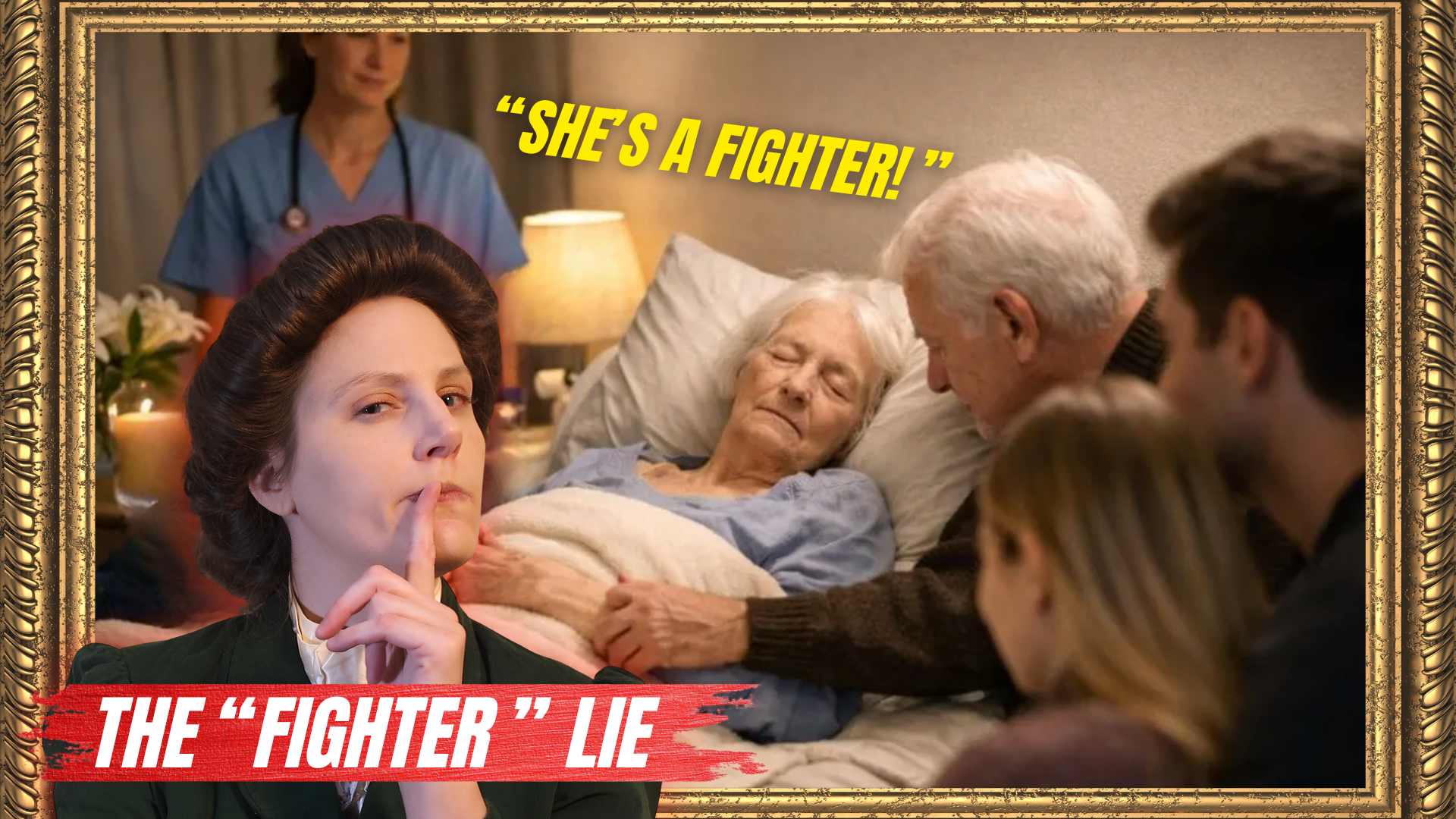
The Truth Behind “She’s a Fighter!”
When a doctor says, “your loved one is terminally ill, you may want to consider hospice,” and a family immediately snaps back with, “No way! She’s a fighter!” or they are yelling at the patient to “Fight!”, what is actually going on beneath the surface? Today, we’re breaking down the hidden psychological reasons, cultural fears, and raw survival tactics behind this phrase. It’s rarely just about “fighting”—it’s about what they are terrified to face.
If you are new here, welcome to Taboo Education, where we talk about death from all angles every Friday. Now let’s talk about telling a dying person to fight.
(I have to credit the Doctor War Games Instagram page for listing many of these points. We are going to go through them and give more of an explanation to each of them. I don’t have any connection to this page, but I have found their page quite interesting and easy to view—no big words, no deep text, just simple cartoons with a lot of great points to make. I would very much recommend it to those people we all know who are not comfortable with this kind of stuff as an easy stepping stone. So go check them out.)
“I’m scared of living without her.” The Fear of Immediate Grief
For many families, agreeing to hospice feels like signing a death warrant. Saying “she’s a fighter” is an emotional defence mechanism against the overwhelming, suffocating fear of the void that will be left behind when their loved one is gone. By focusing entirely on a medical battle, they can successfully delay the agonizing process of anticipatory grief. To them, stopping treatment means confronting the terrifying reality of a world where this person no longer exists.
“My family is completely dysfunctional…” The Distraction from Chaos
In a highly dysfunctional family, a medical crisis acts like a strange kind of glue that forces everyone into temporary alignment. As long as everyone is “fighting” for the patient, they have a common enemy—the illness. This collective focus allows them to actively ignore the toxic dynamics, broken communication patterns, and unresolved trauma waiting for them at home. The frantic energy of a hospital room keeps the family’s deep-rooted issues buried under a layer of medical urgency.
“I don’t trust you.” The Medical Mistrust
When trust in the healthcare system is broken—whether due to past negative experiences, systemic discrimination, or poor communication from the current team—families view hospice recommendations with extreme suspicion. They don’t see it as a compassionate transition; they see it as the hospital “giving up” on them or trying to clear out a bed for a more profitable patient. “She’s a fighter” becomes a defensive shield against an adversarial system they believe is trying to cut corners.

“I read about a miracle survival story.” The Outlier Trap
We’ve all seen the sensational headlines: “Doctors gave her two weeks, but she lived for 10 years!” Families desperately cling to these extreme medical anomalies because they are looking for any shred of hope. They project that one-in-a-million headline onto their loved one’s specific chart. In their minds, accepting hospice means they are actively choosing not to be the miracle story, and they refuse to carry the guilt of walking away from a potential statistical impossibility.
(One of these days we really need to do a video on the toxic positivity media and content creation around dying and disability. Let us know in the comments if that’s a video that you would find interesting.)
“She’s survived so many times before.” The Boy Who Cried Wolf Effect
When a patient has a history of bouncing back from multiple stays in the ICU, the family develops a false sense of security. They’ve watched her beat the odds three, four, or five times already, which normalizes the crisis state. Because she survived the last severe infection or organ failure, the family genuinely believes this is just another standard hurdle she is bound to overcome, making it incredibly difficult for them to recognize when the body has finally reached its physiological limit.
“I don’t want strangers in my house.” The Privacy Protection
Transitioning to home hospice means opening your private sanctuary to a rotating door of nurses, social workers, case managers, and aides. For protective or intensely private families, the phrase “we’re going to keep fighting in the hospital” is often a mask for their deep discomfort with letting outsiders see their messy, vulnerable, or chaotic home life. They would rather endure the sterile restrictions of a hospital than expose their personal environment to strangers.
“This is the 21st century—there must be other treatments!” Faith in Modern Technology
We live in an era of rapid medical advancement, which breeds the cultural illusion that death is ultimately optional if you can just find the right trial, the right drug, or the right specialist. Families feel that stopping aggressive treatment is a failure to properly utilize the tools of the modern world. They view a refusal to try experimental chemotherapy or advanced life support as an unnecessary surrender, equating the sheer existence of medical technology with a guarantee of a cure.
“I need her to live so I can keep getting her paychecks.” The Taboo Financial Reality
It’s the dark, systemic truth nobody wants to say out loud, but it happens frequently. In many low-income or struggling households, a patient’s disability check, pension, or similar is the primary income keeping the entire family housed and fed. Transitioning to end-of-life care threatens the family’s immediate financial survival. When they insist on keeping her alive by any means necessary, they are often fighting to prevent their own immediate financial ruin.
“I live in a culture that is afraid to talk about death.” The Societal Death Taboo
Many different cultures have an issue in talking about death out loud. But modern Western culture largely treats death as a medical failure rather than the natural, inevitable conclusion to a life lived. When families use war metaphors like “she’s a fighter,” they are speaking the dialect of a society that demands toxic optimism at all costs. Because they have never been taught how to have healthy, open conversations about dying, the mere mention of comfort care feels like an unmentionable social taboo that they must aggressively push away.

“She will give up and get depressed in hospice.” The Misconception of Care
There is a massive, widespread misconception that entering hospice means a patient will simply be placed in a dark room, stripped of all dignity, and left to wait for the end. Families worry that removing the goal of a “cure” will crush their loved one’s spirit and cause them to spiral into despair. They don’t realize that hospice is designed to do the exact opposite—removing painful, futile interventions so the patient can actually enjoy their remaining time with family.
“Hospice kills people!” The Morphine Myth
A terrifyingly common and persistent myth is that hospice workers actively hasten death by administering lethal doses of morphine to patients. When a family fiercely rejects a hospice referral, they aren’t just being difficult—they are often reacting out of literal fear for their loved one’s safety. They genuinely believe that signing those papers means handing their relative over to a system that will deliberately shorten their life, rather than managing their pain.
“People will judge me if I don’t look after her myself.” The Burden of Outside Judgment
Guilt and social pressure are incredibly powerful motivators. Caregivers are often terrified of what their extended family, neighbours, or church community will say if they “give up” and hand the patient’s care over to an agency. To them, saying “she’s a fighter” really translates to: “I am terrified of being judged as a lazy, unloving, or abandonment-prone child or spouse by the people in my social circle.”
“She always fought for us! I need to fight for her.” The Debt of Gratitude
This is perhaps the most heartbreaking driver behind the phrase. When a matriarch or patriarch has spent their entire life sacrificing, working multiple jobs, and fighting through adversity to provide for the family, the children feel a profound debt of gratitude. They mistakenly view allowing a peaceful, natural death as a betrayal of that person’s strong legacy, falsely equating modern medical torture with a demonstration of familial love and loyalty.
“Next time you hear someone say ‘she’s a fighter,’ remember it’s rarely about stubbornness—it’s usually a cry of fear, love, or protection.”
Join the Conversation
If you’ve ever had to navigate these difficult conversations in a hospital or with your own family, how did you handle it? Let me know in the comments below. Don’t forget to like, subscribe, and donate to our book project, and I’ll see you in the next video. Now, go talk death!
Advanced Care Workbook
A meticulous guide for cleanly and legally documenting personal and medical values before transitions occur.
Access Digital Workbook →Death Literacy Checklist
An actionable diagnostic tool designed for individuals and workplace teams to gauge existential readiness.
Download Free Audit →
Leave a Reply